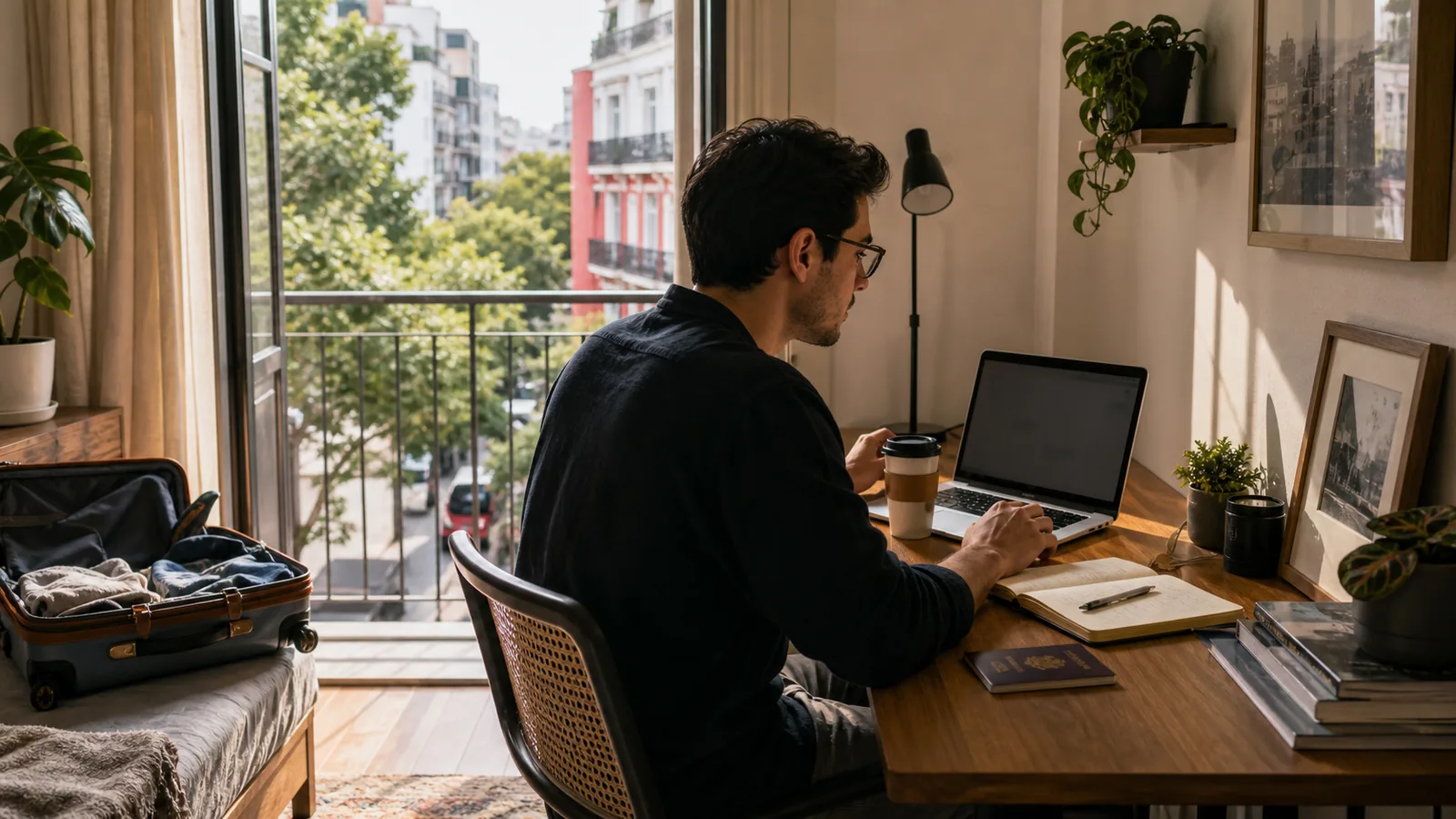
Planning one month in Mexico City as a solo remote worker reshuffles travel priorities fast. The “walkable Sunday brunch” story matters less than whether you can walk to a tienda for oat milk on a Tuesday evening after a long call.
We’ve hosted hundreds of solo remote workers over four years, and two patterns dominate: guests who recharge from city energy after calls, and guests who recharge from quiet before calls. Picking the wrong neighborhood for your pattern ends the same way by week three: you want to switch apartments mid-month, but deposits and re-booking stop most people from doing it.
If you’re still working out the wider Mexico timeline (visa, taxes, banking), start with long-term stay in Mexico for solo remote workers . If the first arrival is still vague (airport, SIM, sleep, first Zoom), read first week in Mexico City as a remote worker .
1. Weekend appeal vs weekday survival
Tourists optimize for museums-per-day and solo remote workers for call-quality-per-week, so they need different apartments.
Before booking, ask for evidence on:
- Upstream bandwidth under load. A Speedtest screenshot is fine, but better is “I had a guest on a 4-hour Zoom last week with no drops.” CDMX residential fiber typically runs 100–500 Mbps down, 50–200 Mbps up. Under 30 Mbps up, expect screen-share stutters.
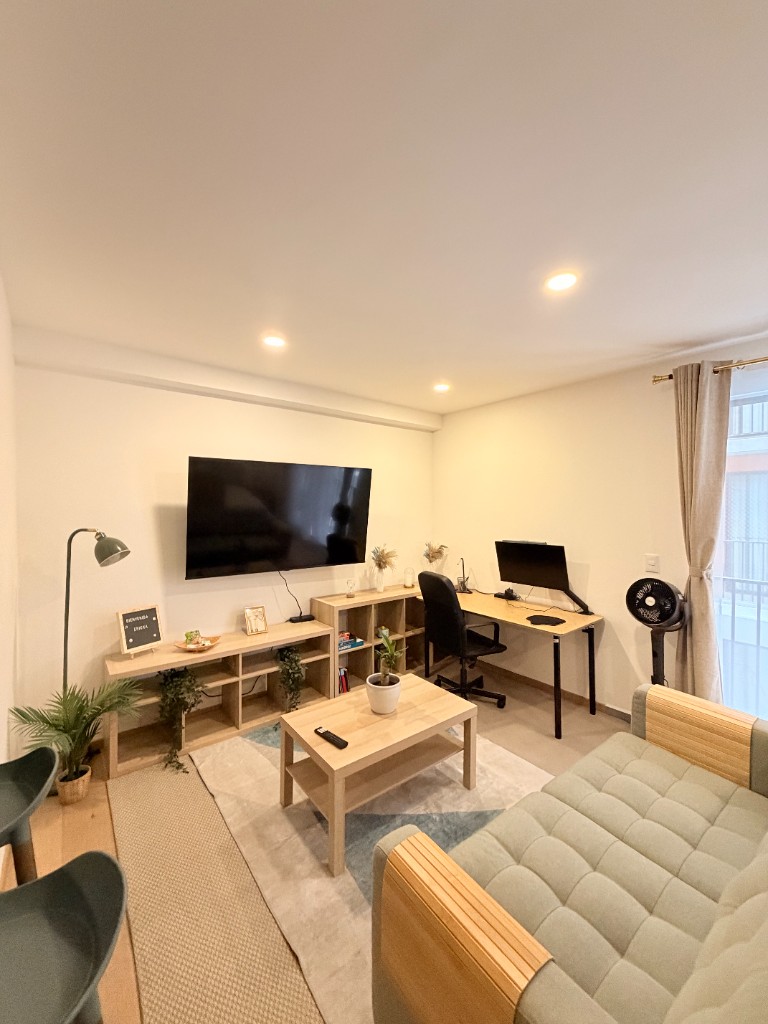
- Chair and desk height. Photograph the desk with a tape measure if you can. A 75 cm dining table is wrong for an 8-hour workday; real desks are 70–73 cm with a chair that adjusts.
- Guest-controlled lighting. Harsh overhead spots wash out faces on video, so a floor lamp or a side window is worth more than a chandelier.
- Humidity in dry season. Valle de México hits 20–30% humidity in January–March, and cracked throats kill calls. Ask whether the unit has a humidifier or if you’ll be buying a $30 USD one on day three.
Photos sell the apartment, but they don’t tell you whether your upstairs neighbor renovates on Wednesdays.
Two questions worth asking the host bluntly:
- “Where do guests do their weekday grocery runs? 15 min walk or 45?” The right answer names the store: Mercado Medellín, La Comer, Walmart Express, Soriana.
- “What time do the garbage trucks hit this block?” CDMX collection runs roughly Mon/Wed/Fri 6–8am; if the building faces a collection point, you’ll hear it.
2. Pick a neighborhood that matches your recharge pattern
Neither Roma Norte nor Narvarte universally wins. Both host serious remote workers all year, and the right pick depends on what you do between calls. (For the wider field first, including Condesa, Del Valle, Escandón, and San Rafael, the best Mexico City neighborhoods for remote workers in 2026 ranking compares them all on noise, rent, transit, and cafe depth.)
Roma Norte for solo remote workers
Pick Roma if you recharge from people around you. It has café density most cities don’t: within a 10-minute walk you have Boicot, Cardinal, Cumbé, Buna, Cielito Querido, plus a dozen smaller specialty spots. You can work in public for three hours, never speak to anyone, and still feel less isolated than in a quiet apartment.
The Orizaba–Medellín–Álvaro Obregón corridor is the daily walk: bakeries open by 7:30am (try Panadería Rosetta or Tres Bellotas for chocolate and coffee before standups). Parque México and Parque España are walking distance for between-call breaks.
Transit anchors: Metro Insurgentes (Línea 1) for north-south, Metrobús Línea 1 on Insurgentes for fast runs to Polanco or Coyoacán, Metro Sevilla (Línea 1) and Chilpancingo (Línea 9) on the south edge. Reforma sits at the north edge for Uber airport runs (~25 min off-peak).
Coworking redundancy: Impact Hub, Privat.MX, Co-Madre, and Colony Spaces are all within walking distance. When the apartment starts feeling small around day 14, you have four options.
Trade-off: pick the wrong micro-block and you’re above a nightclub. Avenues Insurgentes, Cuauhtémoc, and Álvaro Obregón run loud Fri/Sat past 1am. Anything within 50 meters of a bar district will cost you sleep on weekends. If you want Roma’s café density with slightly calmer nights, the Roma Norte vs Condesa monthly stay comparison covers the quieter neighbor block by block.
Narvarte for solo remote workers
Pick Narvarte if you recharge from quiet. It’s residential: fewer tourists, fewer bars, more families and long-term residents. The pace lets you decompress between stakeholder calls instead of context-switching from city noise.
Transit anchors: Metro Eugenia, Metro Nativitas, Metro Portales (all Línea 3), plus Metro Etiopía on the north edge. Metrobús Línea 1 runs Insurgentes Sur, the same route as Roma but quieter where you board. Parque Delta hypermarket complex (Soriana, Walmart-style) is a 10-minute walk from most of Narvarte and handles every grocery, pharmacy, and household need in one stop.
Comparable furnished units typically run 15–25% less per night than in Roma, which over 30 nights is $300–600 USD back in your pocket. The Narvarte remote workers guide maps the cafés, blocks, and weekly rhythm in detail.
Trade-off: the loneliness risk is real if your default is “I’ll figure out the social side once I’m there.” Narvarte takes more deliberate effort: pre-book a Spanish class, set up a SmartFit or coworking day-pass routine, plan two Roma/Condesa evenings a week. Without that scaffolding, the quiet that recharges you on day 5 starts feeling isolating by day 18.
Still undecided? Read Roma Norte vs Narvarte for a month in CDMX for the head-to-head.
3. Lock two transit routes in the first week
Mexico City transit looks intimidating on a map until you’ve done two routes twice. Then it’s boring.
The single best first-week investment for solos: pick the two routes you’ll repeat most, run each once on a calm weekday afternoon with your phone and a little cash, and the rest of the month gets easy.
If Roma Norte is your base, you’re likely between Metro Insurgentes (Línea 1) and Sevilla (Línea 1) or Chilpancingo (Línea 9). Add one Metrobús Línea 1 ride on Insurgentes: the surface route is faster than Metro for several common destinations and runs every 3–5 minutes most of the day.
If Narvarte is your base, Metro Eugenia, Metro Nativitas, or Metro Portales (all Línea 3) will be your daily anchor. Pair with Metrobús Línea 1 (Insurgentes Sur) for Parque Delta and longer routes to Reforma or Polanco.
The Movilidad Integrada card costs $15 MXN one-time and works on both Metro and Metrobús. Top up at any station booth without an app or registration. Cash works at every booth, and although the booth staff don’t speak English at most stations, pointing + the destination name works fine.
The goal is predictable, low-friction commuting on the Thursdays when your meeting stack is the heaviest thing you have to deal with.
Coworking as a release valve, not a default
Apartments often feel smaller on day 17 than they did on day 2, which is normal. The fix is having a backup workspace lined up before you need it.
Treat the first coworking visit as a scouting trip: confirm day-pass price ($150–300 MXN typical), monitor availability, whether they enforce headphones, what hours the building actually opens.
We won’t repeat the full café list here because it drifts seasonally; start from our coffee shops for remote work in Roma Norte guide. Weekday laptop-friendliness differs a lot from weekends: most laptop-tolerant spots in Roma switch to “no laptops after 12pm Sat/Sun” tables, sometimes informally.
The hybrid pattern most successful solos converge on: mornings deep in the apartment, afternoons in a coworking or café for 90 minutes. It moves your legs and breaks the cabin feel, and you get ambient humans without any obligation to small-talk.
4. Friction stacks — small annoyances compound
A month-long stay breaks when five small things compound, not over any single one:
A slightly uncomfortable chair + monitor at the wrong height + construction across the street on Wednesdays + no humidifier in dry season + laundry that requires walking 8 blocks + a couple of rainy-season Uber cancellations = a guest who blames “CDMX overwhelm” on what is actually the apartment’s setup.
Before booking, picture your fourth consecutive Tuesday in this apartment, with your meeting load at its heaviest and the weather working against you. If anything from the list above shows up, fix it at booking: change the apartment, ask the host for a humidifier, plan around the lavandería walk, whatever.
The categories worth pre-budgeting:
| Category | Real probe |
|---|---|
| Food | Nearest produce market open early enough for breakfast prep (Mercado Medellín 8am, Mercado de Sullivan 7:30am, Mercado de la Lagunilla earlier) |
| Mobility | Metro escalator outages on your daily station — Línea 3 stations have been notably patchy in 2026; ask the host which exit actually works |
| Wellness | Park loop (Parque México, Parque Hundido, Parque Delta), gym chain (SmartFit ~$400 MXN/mo), or in-apartment kettlebells |
| Admin | CFDI-compliant invoicing if your employer reimburses — confirm timeline before paying first night |
Anything that adds a new decision every week belongs in the pre-booking checklist.
5. Handle loneliness without forcing nightlife
A solo month only works long-term with what we call purposeful tethering: small, repeating commitments that keep you in contact with people without requiring you to be social on demand.
What works for our guests:
- Rotate two cafés you visit weekly and become a regular at both. Baristas remember your order by week three, and that low-stakes recognition does more for solo morale than two big nights out.
- Schools like Habla Spanish School in Roma or La Catrina in Coyoacán offer week-by-week Spanish conversation classes ($150–300 MXN/hour). They force real-people contact and break expat-only English social bubbles.
- A low-commitment gym membership: SmartFit branches across CDMX run ~$400 MXN/month with no annual contract. The point is the forced eye contact and routine, not the workout.
- Weekday museum mornings. Casa Estudio Luis Barragán, Frida Kahlo House, Tamayo, and MUAC at UNAM are empty on Tuesday mornings and give you a cultural anchor that isn’t about nightlife.
If your default mode is high-social-energy, CDMX rewards it with salsa nights in Roma, mezcalerías in Juárez, and the Wednesday Mama Rumba scene. But protect Sunday and Monday sleep aggressively: a wrecked Monday from Saturday excess sabotages a Tuesday standup faster than any boredom would.
Introverts still need ambient belonging, and we see that misread often. The café crowd is enough: you don’t have to talk, you just have to not be alone in an empty room for three weeks straight.
6. Questions that surface host honesty
Generic “is Wi-Fi okay?” gets you marketing optimism. The questions below force a real answer because there’s no good way to dodge them:
- “What percent of your 25+ night guests come solo? International or mostly domestic?” Tells you whether the host has done this format before, and at what scale.
- “What did your last few solo guests complain about on departure?” A host with a real answer is worth more than one who claims no one ever complains.
- “Which afternoons or evenings are loudest on this block: neighbors, dogs, construction, rooftop bars?” It’s too specific to hedge. If the answer is vague, the host hasn’t lived in the unit.
- “If the internet drops on a Wednesday at 2pm, who do I message and how fast do they respond?” Most listings won’t survive this question.
Escalation matters on a 30-night stay: a minor earthquake (CDMX gets felt-level activity ~once a month), a leaky fixture, summer brownouts during high-rain weeks. Ask directly whether the host dispatches a real maintenance contact or whether you’ll be ghosted between WhatsApp messages.
7. How solo remote workers split between Roma Norte and Narvarte
The pattern we see across solo guests, roughly:
Roma Norte stays go to guests who want a dedicated desk, a dense café/restaurant layer, walking-distance variety so you don’t eat at the same spot four times in a week, and a city that does some of the social scaffolding for you.
Narvarte stays go to guests who want quieter weeknights, lower monthly cost, a predictable grocery routine, and a base that’s calmer to come back to after deep call days. We see a meaningful share of medical residents and nursing staff in Narvarte because Centro Médico (Línea 3 + Línea 9) and Hospital General are walking distance.
Neither pattern is better. Mismatch is what hurts: a quiet apartment for someone who recharges from energy, or a social block for someone who needs quiet recovery between calls.
What a solo month actually costs (2026, MXN)
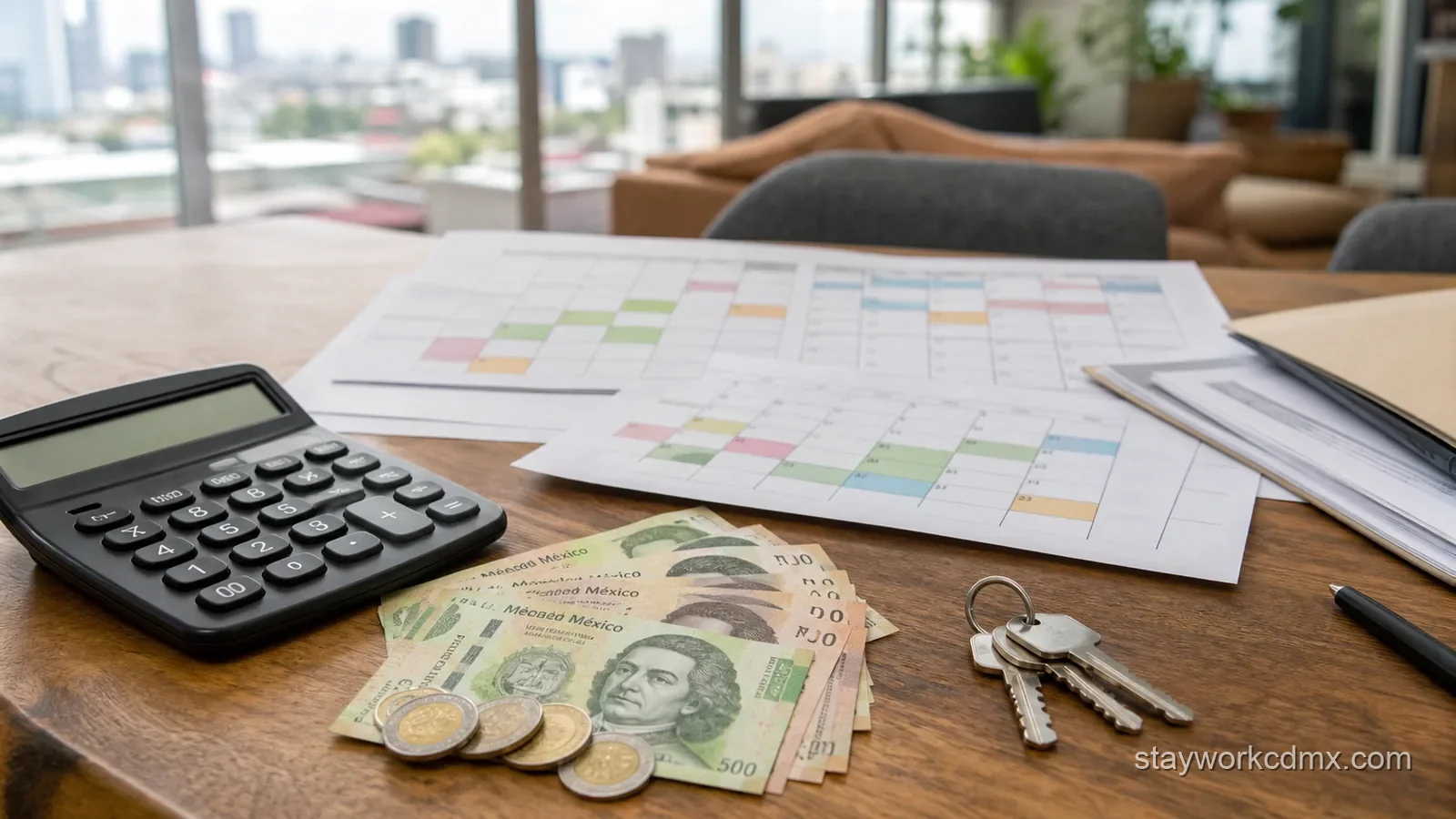
Rent decides most of the budget; everything else moves surprisingly little between neighborhoods. Realistic bands for one person in a work-ready furnished one-bedroom:
| Monthly expense | Narvarte | Roma Norte |
|---|---|---|
| Furnished 1BR (Wi-Fi + utilities included) | $18,000–$28,000 MXN | $23,000–$33,000 MXN |
| Groceries and household basics | $3,500–$5,000 MXN | $3,500–$5,000 MXN |
| Eating out and cafés | $3,000–$6,000 MXN | $3,000–$6,000 MXN |
| Metro, Metrobús, Uber/DiDi | $1,000–$2,000 MXN | $1,000–$2,000 MXN |
| Gym, coworking day passes | $1,000–$2,500 MXN | $1,000–$2,500 MXN |
| Phone data | $200–$500 MXN | $200–$500 MXN |
| Realistic all-in month | $27,000–$44,000 MXN | $32,000–$49,000 MXN |
The eating-out line is the one you control least by willpower and most by neighborhood: Roma’s default dinner runs noticeably higher than Narvarte’s fondas. For a day-by-day version of a residential-side budget, the Del Valle monthly cost and routine breakdown plays out a nearly identical month one block south of Narvarte.
Logistics cross-links before booking
If your evaluation spreadsheet is getting unwieldy, shrink it down using the monthly apartment checklist : direct, mechanical prompts.
If your booking has any corporate finance angle (reimbursement, CFDI invoicing, project codes), read corporate billing, CFDI and compliance in Mexico City . Invoicing requirements are much easier to confirm before paying the first night than after.
When dates are firm, browse furnished apartments in Mexico City directly. We prefer hearing real workload stressors before booking, since it’s much easier to match you to the right unit upfront than to fix a mismatch in week two.
Seasonality that affects mood more than people expect
Dry season (November–April) brings cool nights and harsh daytime sun. Rainy season (May–October) brings short, dramatic afternoon thunderstorms. Both seasons hide air-quality swings that newcomers underestimate.
Temperature inversions in December–February can trap haze over the valley; Reforma vantage points sometimes show it as a brown layer to the north. Spring wind shifts can scrub the sky clean within hours. Check the air-quality index on hazy mornings (AireCDMX is the official source), and swap the outdoor run for a gym day if PM2.5 is over 50.
Practical adaptation matters more than worry: a humidifier with windows closed during dry-cold weeks, an air purifier or sealed windows on construction-dust days, a fan during the brief warm afternoons in April–May. If your mood crashes mid-month, environment is at least sometimes the cause, not just loneliness.
Day 21: when to admit the neighborhood is wrong
By the third week, solo guests usually know whether the block they picked matches their recovery pattern. The failure mode is cumulative friction: you dread walking home after dark, you flinch at every siren, or coworking visits aren’t fixing the loneliness.
Before you blow up the booking, run a one-week experiment with one variable changed: a different morning café, Metrobús instead of walking Insurgentes, a gym class that forces human eye contact, or a hard rule of no weeknight mezcal past 9pm. If the experiment fixes it, the neighborhood was fine and you just needed a small routine tweak.
If the experiment fails and your work quality is sliding, a neighborhood switch is cheap compared to a month of grinding through. We’d rather you message honestly in week three than suffer quietly until departure. The Roma Norte vs Narvarte for a month head-to-head exists because the right answer isn’t universal.
Solo remote workers do best when they treat the CDMX month as a second headquarters: pick a neighborhood that honestly fits how you recharge, lock in the two transit routes you’ll repeat, and line up coworking and a gym before you need them. The city rewards consistency, so plan for repeated Mondays as well as epic Saturdays.