Mexico City furnished apartments with a real separate office room cost $32,000-$85,000 MXN per month (roughly $1,850-$4,850 USD) depending on neighborhood. The best inventory for remote workers is in Roma Norte, Condesa, Polanco, Del Valle, and Narvarte, and all of them have 2-bedroom apartments whose second room works as a home office. A “den” with a desk shoved against the wall doesn’t count. Polanco charges a premium for security and corporate buildings, Roma Norte and Condesa for character and lifestyle, while Narvarte and Del Valle save you 20-30% on the same square footage.
CDMX home office apartments — TL;DR
A “real” home office in Mexico City means: a separate room with a door, an ergonomic chair (not a dining chair), a desk at least 120cm wide, and reliable 100+ Mbps fiber. Budget: $32,000-$45,000 MXN/month for a furnished 2BR in Narvarte, $40,000-$65,000 MXN in Roma Norte or Condesa, $55,000-$85,000 MXN in Polanco. Best ISPs: Totalplay (best fiber), Izzi (cable, second-best). Avoid Telmex DSL apartments for full-time remote work.
A 2BR with home office (from $40,000 MXN/mo in Roma Norte) beats a 1BR + coworking pass ($32,000 + $5,500 = $37,500 MXN/mo) on commute, deep work, and 24/7 access, for a few thousand pesos more per month.
Compare the full furnished market at short term rentals in Mexico City before narrowing to one neighborhood, and use the ranked best neighborhoods in Mexico City for remote workers in 2026 if you are still choosing an area. For digital-nomad-specific inventory (work-ready units, dedicated desks), see digital nomad apartments in CDMX .
Why a Dedicated Office Room Actually Matters
Remote workers have spent five years debating coworking vs home office. For 30+ night stays where work is the main reason for the trip, a dedicated home office room beats both a 1BR with a desk and a coworking membership on commute time, video call quality, and deep-work focus.
The trade-off is cost per square meter: a 2BR with a real office runs roughly 40-60% more than a 1BR with a desk corner. For a 60-90 night stay where you’re working 30-40 hours/week, do that math carefully.
Home office configurations in CDMX — monthly cost and outcome for a remote worker (2026)
| Setup | Roma Norte cost/mo (MXN) | Real work outcome | Best for |
|---|---|---|---|
| 1BR with desk in living room | $28,000-$40,000 | Constant context switching; video calls visible to anyone home | Solo travelers, light remote work |
| 1BR + coworking hot desk | ~$32,000 + $5,500 = $37,500 | Commute (15-20 min ×2); shared workspace; better focus | Social workers, hybrid schedules |
| 2BR with dedicated office room | $40,000-$60,000 | Zero commute; dedicated calls room; deep work all-day | Full-time remote, focused workers |
| 2BR + upgraded office furniture | $45,000-$65,000 | Same as above + ergonomic real desk + external monitor | Senior remote workers, full-time |
| Studio + coworking dedicated desk | ~$20,000 + $8,500 = $28,500 | Cheaper apartment but workspace permanently outside home | Cost-conscious, social workers |
Serious remote workers should weigh two options: a 2BR with a real office (best work outcome, premium cost) and a studio + dedicated coworking desk (cheaper apartment, externalized workspace). Over a 30+ night stay, the 1BR with a corner desk consistently underperforms, because living without physical separation between work and life is harder than a one-week sample suggests.
What Counts as a “Real” Home Office in CDMX
Not every “2BR” in CDMX has a usable office. Watch for these:
The “office” is a service room (cuarto de servicio). Older Polanco and Roma Norte buildings often include a small room originally built for live-in domestic help. These rooms work as offices but are typically:
- 6-8m² (vs 10-14m² for a real second bedroom)
- No windows or one tiny window
- Separate from the main bathroom (often has its own small bathroom or shared with kitchen access)
- Acoustically isolated from the rest of the unit: sometimes a feature, sometimes a problem
If you’re six feet tall, claustrophobic, or need natural light, service-room offices don’t work. Verify with floor plan + photos before booking.
The “office” is a den with no door. Some open-plan 2BRs in newer Roma Norte and Condesa buildings have a “loft office”: a desk area on a mezzanine or open to the living room. Beautiful in photos, terrible for video calls and deep work. Ask whether the office has a door that closes.
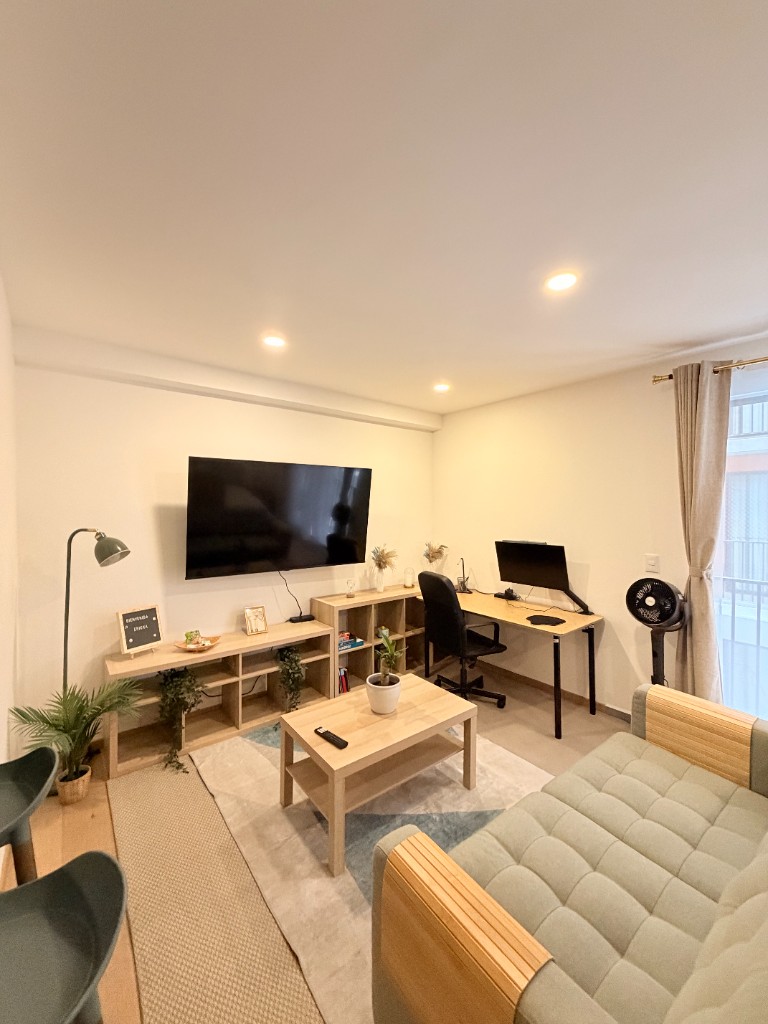
The “second bedroom” is the office. This works and is increasingly the standard for digital nomad 2BRs: the room has a closet, a window, and full-size space for a desk and storage. The trade-off: no guest bedroom for visitors.
The acoustic problem. CDMX construction is mostly concrete and tile, so video call audio echoes and noise carries between rooms. The remote-worker fix is soft surfaces (rugs, curtains, plants, soft furniture) instead of bare walls and tile floor. Ask for photos of the office furniture and walls before booking.
Best Neighborhoods for Furnished Apartments with a Separate Office
Roma Norte: The Default Choice
Roma Norte has the most 2BR furnished inventory aimed at remote workers. Most units are in early-1900s buildings converted to modern furnished rentals, with high ceilings (3.5-4m), character, and often two real bedrooms.
What to expect:
- 2BR furnished: $40,000-$60,000 MXN/month (~$2,300-$3,450 USD), ~70-95m²
- Totalplay fiber: standard, 200-500 Mbps
- Light: typically good (large windows facing street or interior courtyard)
- Acoustic: variable (high ceilings + tile floors = echoey; soft furnishings help)
- Best blocks for home office: side streets off Av. Álvaro Obregón (Querétaro, Mérida, Tabasco), quieter than the avenue itself
See Roma Norte apartments for the current inventory, or the Roma Norte remote-worker profile for how the neighborhood works across a full workweek.
Condesa: The Quieter Premium
Condesa 2BRs typically have slightly more residential calm than Roma Norte, often in art deco buildings (1930s-1940s) with similar high ceilings and natural light.
What to expect:
- 2BR furnished: $42,000-$65,000 MXN/month (~$2,400-$3,700 USD), ~70-100m²
- Av. Amsterdam and surrounding streets: tree-lined, quieter than Roma Norte avenues
- Parque México area: residential, slower pace
- Acoustic: similar to Roma Norte but generally quieter ambient noise
If the Roma-or-Condesa question is holding up your booking, the Roma Norte vs Condesa monthly stay comparison settles it on workweek criteria (noise, cafes, parks, and cost) instead of reputation.
Polanco: The Premium with Real Inventory
Polanco has the largest 2BR furnished inventory and the most “corporate-grade” buildings (24/7 doorman, package room, gym, often parking included).
What to expect:
- 2BR furnished: $55,000-$85,000 MXN/month (~$3,150-$4,850 USD), ~85-120m²
- Modern construction more common (1990s-2010s buildings)
- Acoustic: better than Roma/Condesa due to newer construction with drywall + insulation
- Building amenities: gym, rooftop terrace, package room standard
- Best for: senior remote workers, dual-income households, anyone who needs premium home office reliability
For corporate clients, see corporate housing in Mexico City .
Narvarte: The Smart-Money Home Office
Narvarte is the smart-money pick for home office stays: the same 2BR floor plans as Roma Norte/Condesa at 20-30% lower cost.
What to expect:
- 2BR furnished: $32,000-$45,000 MXN/month (~$1,850-$2,600 USD), ~70-95m²
- Quieter residential streets (better acoustics for video calls)
- Totalplay fiber: standard
- Less character (mostly 1970s-1990s buildings) but functional and well-built
- Less remote-worker social density, the trade-off for the savings
See Narvarte apartments for the area overview and bookable 30+ night units. For what a Narvarte workweek feels like (cafes, gyms, quiet blocks, Metro access), read the Narvarte guide for remote workers .
Del Valle: The Quieter Narvarte Alternative
Del Valle sits directly south of Narvarte, with wider, greener streets and an even calmer residential rhythm. It has arguably the best acoustics for video calls of any neighborhood on this list.
What to expect:
- 2BR furnished: $33,000-$46,000 MXN/month (~$1,900-$2,650 USD), ~75-100m²
- Very quiet residential blocks; ambient noise is rarely a call problem
- Totalplay and Izzi fiber widely available
- Thinner cafe and coworking density than Roma Norte, so you work from home here by design
- Metrobús Línea 2 and Metro División del Norte cover cross-city trips
As in Narvarte, you give up social density for budget headroom and quiet. The Del Valle monthly cost and routine breakdown for remote workers itemizes a full month there (rent, groceries, gym, transit) if you want to see the numbers before shortlisting it.
Google Maps perimeter check - Roma Norte vs Narvarte
Roma Norte search area
Narvarte search area
The Internet Reality for CDMX Home Offices
Internet is the single most important factor for a CDMX home office and the most common blind spot before booking.
Provider ranking:
- Totalplay (fiber): best for download, upload, and latency. Standard in newer Roma Norte/Condesa/Narvarte buildings; plans typically 200-500 Mbps.
- Izzi (cable): second-best. Good download, decent upload. Standard in many older buildings. 100-300 Mbps typical.
- Telmex Infinitum (DSL or fiber): variable. Telmex fiber is fine, but avoid Telmex DSL, which many older Polanco buildings still have.
- Megacable: regional and less common in central CDMX.
Pre-booking questions:
- What’s the internet provider? (Reject Telmex DSL for full-time work)
- What’s the plan speed? (Aim for 100+ Mbps down / 30+ Mbps up)
- Is the connection a dedicated home line or a shared building connection? (Dedicated is better)
- Is there a backup mobile hotspot option? (4G/5G coverage in central CDMX is excellent, so a Telcel, AT&T, or Movistar eSIM works as failover)
For the full digital-nomad cost picture, including internet, see cost of living in Mexico City for digital nomads .
Office Furniture: What “Furnished” Actually Provides
What “furnished” includes varies wildly. For a real home office, verify:
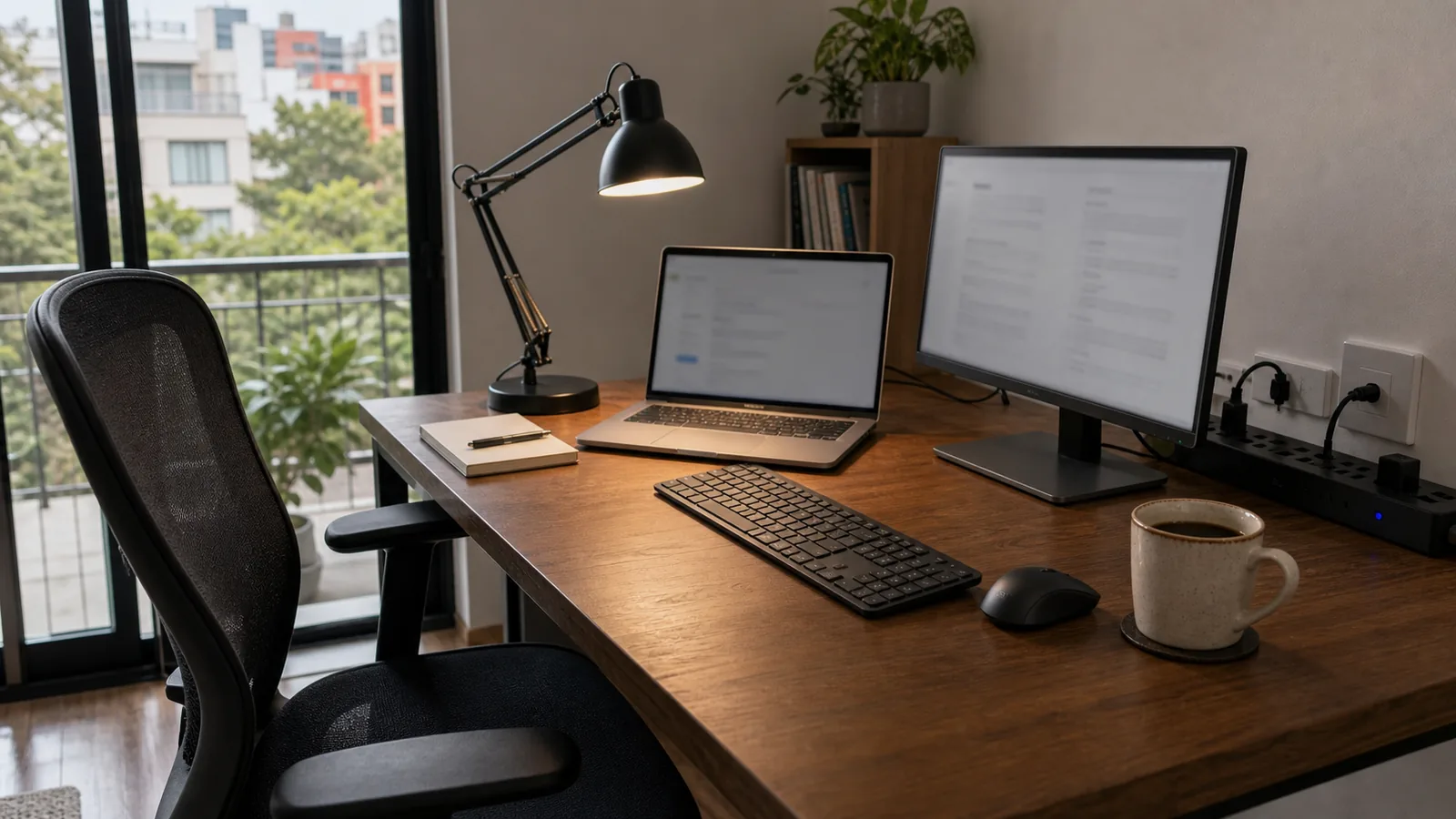
- Desk: 120cm minimum width, ideally 140-160cm. Not a dining table doubling as a desk.
- Chair: an office chair with lumbar support and height adjustment, not a kitchen chair or stool. Look for Herman Miller (rare), Steelcase, IKEA Markus, or IKEA Hattefjäll. Anything not ergonomic for 8 hours/day means back pain by week three.
- Lighting: natural light from the side, not from behind (which silhouettes you on video calls), plus a desk lamp for evening work.
- Outlets: 3+ outlets near the desk, preferably with surge protection. CDMX power is reliable, but you need power strips for laptop, monitor, and phone charging.
- Window orientation: south-facing for max winter light (CDMX is at 19° latitude, so sun angles work differently than at higher latitudes).
If the apartment’s furniture falls short, budget $100-200 USD for an external monitor and possibly a second-hand ergonomic chair from MercadoLibre, which is worth it for 60+ night stays.
For the broader furnished checklist, see the monthly apartment checklist .
Home Office vs Coworking: The Real Math
Remote workers planning a CDMX stay often ask: “Why not just get a cheap apartment and a WeWork pass?”
The math, for a 60-night stay in Roma Norte:
Option A: 1BR + coworking hot desk
- 1BR apartment: ~$32,000 MXN × 2 months = $64,000 MXN
- Coworking hot desk: ~$5,500 MXN × 2 months = $11,000 MXN
- Daily commute (15 min × 2 × 40 work days) = 20 hours
- Total: ~$75,000 MXN + 20 hours commute over 2 months
Option B: 2BR with home office
- 2BR Roma Norte: ~$48,000 MXN × 2 months = $96,000 MXN
- Optional cafe day passes (1-2x/week): ~$900 MXN/month × 2 = $1,800 MXN
- Total: ~$97,800 MXN + 0 commute time
The home office option costs about $11,400 MXN (~$650 USD) more per month, saves 10 hours per month, and gives you a door that closes for every call. For a senior remote worker billing $50+ USD/hour, the recovered commute time alone covers most of the gap. Option A holds up for junior workers or anyone who really benefits from coworking’s social side. If the budget is the deciding factor, run Option B in Narvarte instead, where a full 2BR ($32,000-$45,000 MXN) costs about the same as a Roma Norte 1BR.
For the broader furnished vs coliving vs Airbnb comparison, see coliving vs furnished apartment in CDMX .
What a Home-Office Month Costs All-In (2026, MXN)
Rent is the biggest line. A realistic month for one remote worker in a 2BR with a dedicated office breaks down like this:
| Budget line | Narvarte / Del Valle | Roma Norte / Condesa |
|---|---|---|
| Furnished 2BR with office | $32,000-$45,000 MXN | $40,000-$60,000 MXN |
| Groceries | $3,500-$5,000 MXN | $3,500-$5,000 MXN |
| Eating out (10-12 meals) | $2,500-$4,500 MXN | $3,000-$5,500 MXN |
| Transit + occasional rideshare | $800-$1,500 MXN | $800-$1,500 MXN |
| Laundry + phone data | $700-$1,100 MXN | $700-$1,100 MXN |
| Cafe or coworking day passes | $500-$1,000 MXN | $500-$1,500 MXN |
| Realistic all-in total | $40,000-$58,100 MXN | $48,500-$74,600 MXN |
Two levers dominate this table: the neighborhood you pick and how often you eat out. A Narvarte or Del Valle base saves $8,000-$16,000 MXN per month on the housing line alone against Roma Norte, enough to fund the entire non-rent budget. Everything else is rounding error by comparison.
Once you’ve decided a real home office is the right setup, book direct to verify the office-room specifics: door, dimensions, ergonomic furniture, real desk size, internet provider and speed. These details rarely show up clearly in photos, and a 5-minute conversation before booking saves you from 60 nights of poor work conditions.