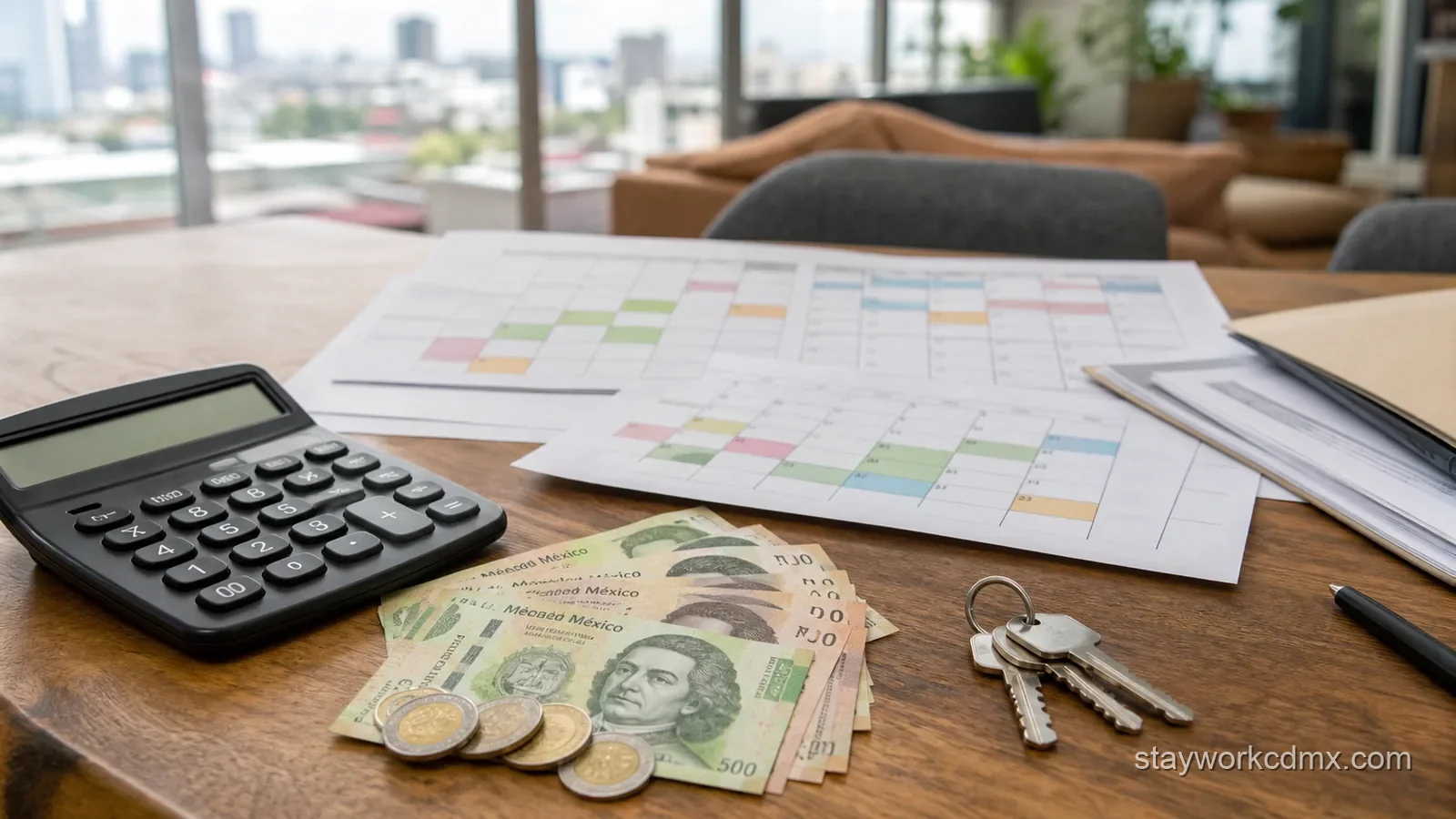
If you are searching for a long-term stay in Mexico as a solo traveler working remotely, start with one rule: optimize for your weekdays, not your first weekend.
For 30+ day stays, the best place is the one that keeps your work reliable, your routine simple, and your total friction low. A rooftop view sells the booking. A quiet room, a real desk, and Wi-Fi that survives a 9 a.m. video call are what you actually live with on day 19.
This guide covers the three decisions that determine whether a long stay works — the city, the neighborhood, and the apartment — plus realistic MXN budgets, visa basics, and the checks that separate a good month from an expensive lesson.
Quick answer
For most solo remote workers, Mexico City is the strongest first base for a long-term stay because it combines:
- Deep furnished monthly inventory
- Better neighborhood variety for different work styles
- Strong café and coworking ecosystems
- Easy domestic and international flight access
If you are deciding at city level first, Mexico City is usually the highest-probability choice before testing smaller cities. Budget roughly $34,000–$49,000 MXN (about $1,950–$2,800 USD) for a comfortable month including rent, and choose your neighborhood by work rhythm rather than by reputation.
What to prioritize before choosing any city in Mexico
Use these five filters in this order:
- Workspace reality: Real desk/chair and call-friendly setup
- Internet stability: Reliable Wi-Fi for daily meetings
- Noise profile: Block-level noise, not just neighborhood reputation
- Walkability and transit: Daily errands without high decision fatigue
- Monthly fit: Cost and comfort that still make sense on day 25
Most bad long-term bookings fail because one of these basics was assumed instead of confirmed. Notice what is missing from the list: photos, design, and the view. Those matter for a weekend. They almost never determine whether a month goes well.
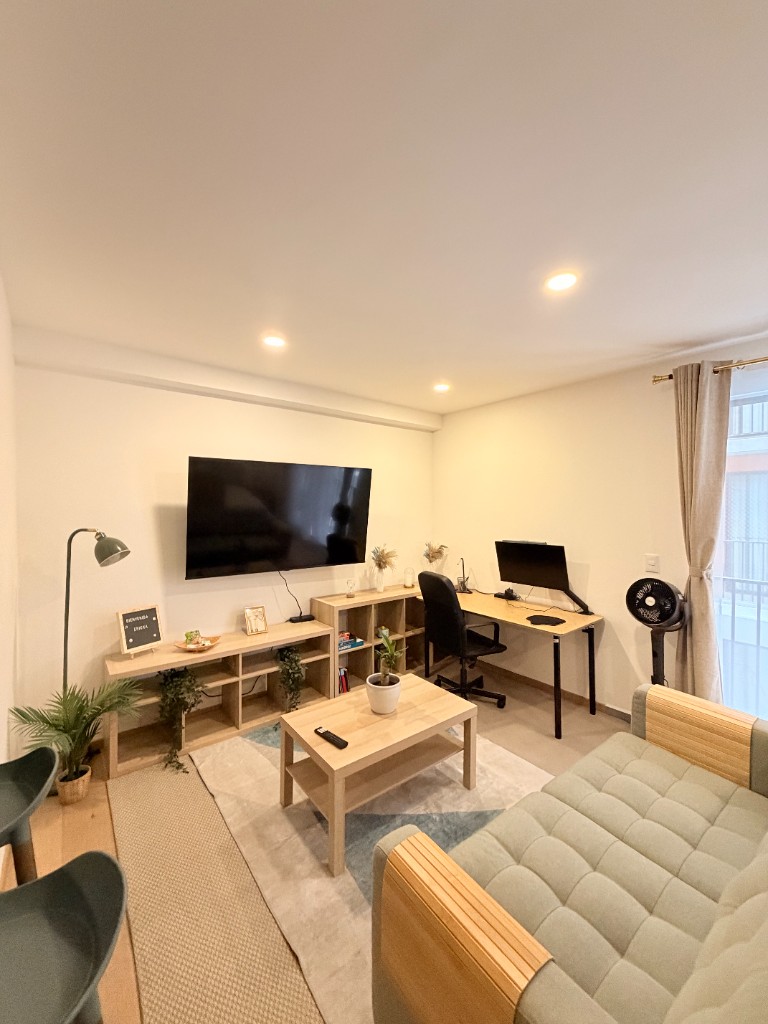
Why Mexico City is usually the best first long-term stay
For solo remote workers, Mexico City has a practical advantage: it offers more “good enough” options across different budgets and routines than almost any other city in Mexico.
That matters more than it sounds. In a smaller city, a bad apartment choice is hard to fix — the furnished inventory that suits remote work might be a dozen units citywide. In CDMX, if Roma Norte turns out to be louder than you expected, Narvarte, Del Valle, or Escandón are a 15-minute ride away with completely different rhythms and prices.
How Mexican cities compare for a work-heavy month
| City | Furnished 1BR planning range | Best for | Main tradeoff |
|---|---|---|---|
| Mexico City | $22,000–$46,000 MXN | Deepest inventory, coworking, flights, neighborhood choice | Altitude, traffic, size can overwhelm at first |
| Guadalajara | $18,000–$32,000 MXN | Tech scene, lower rents, easier scale | Thinner furnished monthly supply, hotter spring |
| Monterrey | $20,000–$36,000 MXN | Corporate and industrial work, US time-zone alignment | Very hot summers, car-dependent |
| Mérida | $16,000–$28,000 MXN | Calm, safe, low costs, colonial walkability | Heat and humidity, small café/coworking scene |
| Oaxaca | $14,000–$26,000 MXN | Food, culture, low cost, creative work | Least reliable internet, limited flights |
| Puebla | $13,000–$24,000 MXN | Cheapest central option near CDMX | Quieter social scene for solo travelers |
| Playa del Carmen | $20,000–$40,000 MXN | Beach routine, established nomad community | Seasonal price swings, transient social layer |
CDMX figures come from our own furnished monthly inventory and market tracking; the other cities are directional planning estimates for work-ready furnished units booked for 30+ nights. Rates in every city move with season, exact block, and how far ahead you book.
The short version: Mexico City costs more than most alternatives but reduces the number of things that can go wrong. For a first long stay, that is usually the right trade. For the full cost picture, read the furnished monthly apartment cost guide for Mexico City .
Choosing your neighborhood in Mexico City
Inside CDMX, most solo remote workers end up comparing four or five neighborhoods. They are not interchangeable, and the difference shows up in your weekday far more than your weekend.
- Roma Norte: Better for social rhythm, cafés, and coworking density
- Narvarte: Better for quieter nights and stronger monthly value
- Condesa: Better for green, walkable routines with a softer pace
- Del Valle: Better for space, calm, and excellent Metro/Metrobús access
- Polanco: Better for premium corporate comfort and services
Use the best neighborhoods in Mexico City for remote workers in 2026 for the full map. If your shortlist has already narrowed to the two most popular options, Roma Norte vs Condesa for a monthly stay settles that comparison directly.
What each neighborhood costs per month
These are realistic 2026 ranges for furnished, work-ready units booked for 30+ nights:
| Neighborhood | Furnished 1BR | Furnished 2BR | Private furnished room |
|---|---|---|---|
| Narvarte | $22,000–$32,000 MXN | $32,000–$45,000 MXN | $9,000–$14,000 MXN |
| Del Valle | $23,000–$34,000 MXN | $34,000–$48,000 MXN | $9,500–$15,000 MXN |
| Juárez | $26,000–$38,000 MXN | $36,000–$52,000 MXN | $10,000–$16,000 MXN |
| Roma Norte | $28,000–$42,000 MXN | $40,000–$60,000 MXN | $11,000–$17,000 MXN |
| Condesa | $30,000–$46,000 MXN | $44,000–$65,000 MXN | $12,000–$18,000 MXN |
| Polanco | $40,000–$60,000 MXN | $58,000–$90,000 MXN | — |
The gap between Narvarte and Condesa is roughly $8,000–$14,000 MXN per month for a comparable one-bedroom. Over a three-month stay that is $24,000–$42,000 MXN — enough to fund flights home, a coworking membership, and several weekends away.
What the premium buys is location feel, not apartment quality. At the same price point, Narvarte and Del Valle units are usually larger, newer, or better equipped for daily work. That is the single most useful thing a solo remote worker can know before booking.
Narvarte: the default value pick
For a solo traveler whose month is mostly weekdays, Narvarte is the neighborhood we recommend most often. It sits south of Roma Sur and east of Del Valle on wide, tree-lined streets, with Parque Delta for groceries and errands and an unusually deep bench of fondas and taquerías that serve residents rather than visitors.
Transit is the quiet advantage: Metro Line 9 along Eje 4 Sur, Line 3 to the west, and Metrobús on Cuauhtémoc put Roma Norte 10–15 minutes away. You get Roma when you want it and quiet when you need it. The Narvarte remote workers guide covers the block-level detail, and you can compare live options on Narvarte furnished monthly apartments .
Del Valle: more space, same calm
Del Valle is Narvarte’s slightly more polished neighbor — larger units, wider sidewalks, more supermarkets, and strong north-south transit. It suits solo workers who want an apartment they can actually spread out in, or who take enough calls that a separate room matters. The Del Valle monthly cost and routine guide breaks down what a typical week costs there.
Roma Norte: when you want the city at your door
Roma Norte earns its price if you genuinely work outside the apartment several days a week. Café density is real, coworking is walkable, and the social layer means a solo stay does not have to be a solitary one. The tradeoffs are noise on the busier corridors and a food budget that inflates almost by itself. Browse current options on Roma Norte monthly stays .
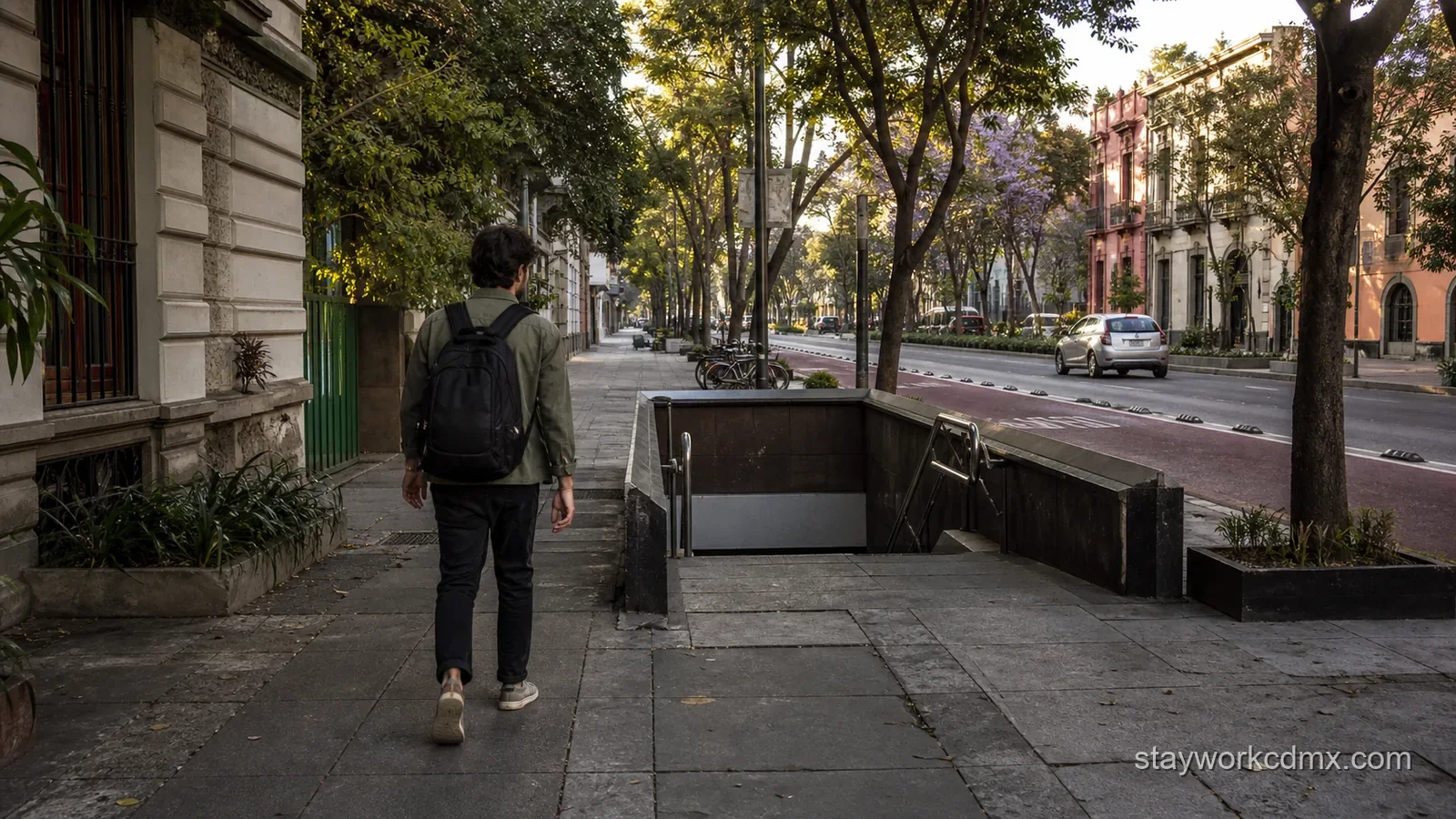
A realistic monthly budget for a solo remote worker
Rent is the biggest line, but it is not the month. Here is what a solo remote worker actually spends across 30 nights in a central CDMX neighborhood, at roughly 17.5 MXN per USD.
| Expense | Range (MXN) | Notes |
|---|---|---|
| Furnished 1BR (utilities + Wi-Fi included) | $24,000–$34,000 | Narvarte or Del Valle; add $6,000–$12,000 for Roma Norte or Condesa |
| Groceries | $3,000–$5,000 | Cooking most days; Chedraui, Walmart, or the local mercado |
| Meals out and delivery | $3,000–$6,000 | Everything from $50-peso tacos to $800-peso dinners |
| Metro and Metrobús | $200–$400 | $5–6 MXN per ride |
| Uber and Didi | $800–$1,500 | Evenings, rain, and airport runs |
| Coworking or café working | $0–$2,500 | Many cafés welcome laptops; day passes run $150–$300 MXN |
| Laundry | $300–$600 | Drop-off lavandería by the kilo |
| Phone and data | $200–$400 | Telcel or AT&T prepaid |
| Gym or fitness | $0–$1,200 | Neighborhood gyms; some buildings include one |
| Comfortable monthly total | $34,000–$49,000 MXN | ≈ $1,950–$2,800 USD |
Three budget tiers
| Tier | Housing choice | Everything else | Total per month |
|---|---|---|---|
| Lean | Private furnished room in Narvarte or Del Valle | $9,000–$12,000 MXN | $21,000–$36,000 MXN (≈ $1,200–$2,050 USD) |
| Comfortable | Furnished 1BR in Narvarte, Del Valle, or Juárez | $10,000–$15,000 MXN | $34,000–$49,000 MXN (≈ $1,950–$2,800 USD) |
| Central premium | Furnished 1BR in Roma Norte or Condesa | $12,000–$20,000 MXN | $42,000–$66,000 MXN (≈ $2,400–$3,770 USD) |
The most volatile line is restaurant spending, and it is strongly neighborhood-driven. In Narvarte, a comida corrida runs $90–$150 MXN and you eat out without thinking about it. In Condesa, the equivalent lunch is $250–$400 MXN and the daily specialty coffee adds up to another $1,500 MXN a month. Same person, same habits, very different totals.
For the complete personal-finance view beyond housing, use the cost of living in Mexico City for remote workers in 2026 .

Visas and paperwork for a 30+ day stay
For a one- to three-month stay, most solo remote workers do not need anything beyond a tourist entry.
- Tourist entry: US, Canadian, UK, EU, and many other passport holders enter without a visa and receive a stay permit of up to 180 days. The officer at the airport decides the number of days written on your entry record — it is discretionary, not automatic, so have your return flight and accommodation address ready.
- Working remotely on a tourist entry: Working online for clients or an employer outside Mexico is the normal case for remote workers. You cannot take local employment or earn income from a Mexican source on a tourist permit.
- Longer than 180 days: Apply for temporary residence at a Mexican consulate in your home country before you travel. It cannot be started from inside Mexico on a tourist permit. See the Mexico residence permit guide for digital nomads .
- RFC and CURP: Only relevant if you need Mexican tax registration or a local contract. Most monthly-stay guests never need either. If you do, read the CURP and RFC guide for foreigners .
One practical note that trips people up: a furnished monthly stay normally requires only a deposit, ID verification, and written booking terms. A traditional Mexican lease often requires a fiador — a local guarantor who owns property in the city — which is exactly why long-stay visitors use furnished rentals instead. The renting in Mexico without a fiador guide explains the difference.
Safety and daily logistics for solo travelers
Mexico City is a large capital, and the honest framing is that it behaves like one. Solo remote workers do well here, but the rules are ordinary big-city rules applied consistently.
- Safety is block-specific, not neighborhood-wide. A well-lit street with a doorman in a “mid-tier” colonia beats a dark corner in a famous one. Check the exact address on street view before booking.
- Use Uber or Didi at night rather than hailing street taxis. Fares are low and the trip is tracked.
- Keep your phone out of sight while walking and on the Metro. Phone snatching is the most common issue visitors encounter, and it is almost entirely avoidable.
- Metro at rush hour has women-and-children-only cars at the front of the train. They are well enforced and worth using.
- Carry some cash. Markets, fondas, and small laundries are cash-first, and $500–$1,000 MXN in small bills removes daily friction.
- Register your address with whoever you check in with, and confirm a support contact you can reach during the stay.
For a neighborhood-by-neighborhood read, see is Mexico City safe for a monthly stay . Solo women travelers may also want the best Mexico City neighborhood for women solo remote workers .
One more logistical detail that surprises people: Mexico City sits at 2,240 metres. Most visitors feel it for two or three days as poorer sleep, shortness of breath on stairs, and lower alcohol tolerance. Plan a light first week rather than scheduling your heaviest work immediately after landing — the CDMX altitude guide for remote workers covers the adjustment.
Solo-traveler long-stay checklist
Before you pay, ask directly:
- Is this unit truly suitable for someone working from home most weekdays?
- Is the desk setup good enough for daily calls, or is it a dining table with a chair?
- What is typical nighttime noise on this exact block, including weekends?
- What is the actual Wi-Fi speed, and is there a backup if the provider goes down?
- What do month-long solo guests usually like and dislike about this unit?
- Is check-in easy if my flight is delayed?
- Are utilities, Wi-Fi, and cleaning included in the quoted monthly rate?
- What is the deposit, and when is it returned?
- Is there laundry in the unit or building, and if not, how far is the nearest lavandería?
- Who do I contact if something breaks on a Saturday?
These questions usually reveal fit faster than generic messages — and how a host answers them tells you as much as the answers themselves. The monthly apartment checklist is the longer version to work through before you commit.
When to book, and what it costs to get it wrong
Timing matters more for long stays than for short ones, because the inventory that suits a month is a small slice of the total market.
| Period | How far ahead to book | Why |
|---|---|---|
| Standard months (Feb–May, Aug–Oct) | 3–6 weeks | Best mix of choice and price |
| Day of the Dead (late Oct–early Nov) | 3–4 months | Central inventory sells out first |
| Mid-December to early January | 2–3 months | Holiday demand plus returning families |
| Semana Santa (Mar–Apr) | 2–3 months | Domestic travel peak |
| World Cup window (Jun–Jul 2026) | 4–6 months | Exceptional demand across all central neighborhoods |
The cost of booking late is rarely a higher headline rate. It is a worse apartment at the same rate — the street-facing unit instead of the interior one, the dining table instead of the desk. For an event-heavy month, read what to expect in CDMX for the 2026 World Cup .
Common mistakes solo remote workers make
- Booking nightly for a monthly stay. Platform nightly pricing plus service fees can add $10,000–$20,000 MXN over 30 nights versus a direct monthly rate. See book direct vs Airbnb for monthly apartments .
- Choosing the neighborhood before the apartment. The colonia name does not fix a noisy street-facing bedroom.
- Over-indexing on the first weekend. A place that is thrilling on Saturday can be exhausting by Wednesday. Pick for Tuesday at 10 a.m.
- Not confirming what “furnished” includes. Linens, kitchen equipment, cleaning cadence, and utility handling vary enormously.
- Booking too central. Solo workers frequently pay a premium for walkable nightlife they use twice, then work through it every weeknight.
- Ignoring the desk. It is the single most predictive item in the entire listing.
Best starting path if you are still comparing options
If you have not picked your exact unit yet:
- Start with furnished monthly apartments in Mexico City
- Narrow your neighborhood with the best neighborhoods for remote workers in 2026
- Work through the monthly apartment checklist before you send a booking request
If you already know your dates and work style, go directly to book direct to check live availability and monthly fit.
Bottom line
For the query “long-term stay in Mexico for solo travelers working remotely,” the most practical answer is usually:
- Start in Mexico City — it has the deepest furnished inventory and the most ways to correct a bad first choice
- Choose the neighborhood by work rhythm, not reputation: Narvarte or Del Valle for value and quiet, Roma Norte if you work outside the apartment
- Budget $34,000–$49,000 MXN for a comfortable month, or $21,000–$36,000 MXN for a leaner one
- Confirm workspace, Wi-Fi, and block noise in writing before booking
- Optimize for a stable month, not a photogenic weekend
That approach gives solo remote workers the highest chance of a productive, low-friction long-term stay in Mexico.
FAQ
How much does a month in Mexico City cost for a solo remote worker?
Plan for roughly $34,000–$49,000 MXN (about $1,950–$2,800 USD) for a comfortable month in a furnished one-bedroom in a central neighborhood, covering rent, groceries, meals out, transport, and daily expenses. A leaner month built around a private furnished room in Narvarte or Del Valle can land closer to $21,000–$36,000 MXN.
Which Mexico City neighborhood is best for a solo remote worker?
Narvarte is the strongest value choice for a work-heavy month: quiet nights, larger units, and rents roughly 20–30% below Roma Norte, with Roma reachable in 10–15 minutes. Choose Roma Norte instead if café and coworking density within walking distance is what makes your week work.
Do I need a visa for a long-term stay in Mexico?
Most US, Canadian, UK, and EU passport holders enter as tourists and receive a stay permit of up to 180 days, which covers a typical one- to three-month remote-work stay. The exact number of days is set by the immigration officer at entry. For stays beyond 180 days, apply for temporary residence at a Mexican consulate before you travel.
How far in advance should I book?
Three to six weeks ahead for a standard month. Three to four months for Day of the Dead, the December holidays, or Semana Santa, and four to six months for the 2026 World Cup window — good furnished inventory in central CDMX goes first.
Is it safe to stay in Mexico City alone for a month?
Yes, for most solo remote workers using ordinary big-city precautions. Safety is block-specific rather than neighborhood-wide, so choose a well-lit street with building access control, use Uber or Didi at night, and keep your phone out of sight on the street and on the Metro.
Is a furnished monthly apartment cheaper than a hotel or Airbnb?
For 28+ nights, almost always. A direct monthly rate skips platform service fees of roughly 15–20% and includes utilities, Wi-Fi, and cleaning, which a hotel bills separately or not at all. Over 30 nights the difference is commonly $10,000–$20,000 MXN.