We’ve hosted over 300 guests on furnished short-term rentals in Mexico City, and most arrive somewhere between “this is longer than a hotel feels right for” and “I’m not ready to sign a year lease.” That gap is wide: a 10-night project sprint, a 3-week trial stay before relocating, a scouting visit before a corporate move, or a month booked one week at a time because the calendar keeps shifting.
Every listing claims to be furnished, so the useful question is whether the stay format fits how you’ll live in CDMX once the novelty wears off: working Tuesday through Thursday, cooking after a long day instead of eating out a fourth night in a row, sleeping through Insurgentes traffic, and navigating ProAire car restrictions if you’re driving in.
The pattern we see almost every week:
- Under 2 weeks, convenience dominates, and a hotel-style furnished rental near Reforma or Polanco works fine
- At 2 to 4 weeks, flexibility still matters, but Wi-Fi quality, kitchen completeness, laundry access, and a real workspace start deciding whether week three feels sustainable
- At 30+ nights, the booking is functionally a monthly apartment decision: routine, total cost, transit access, and neighborhood fit outrank everything else
Moving to Mexico City Checklist: before you book a short-term stay
If you are relocating or arriving for a long project, run this checklist before booking: (1) confirm your visa and entry stamp length; (2) sort your CURP and RFC early, using our CURP guide if you do not have them; (3) open a Mexican bank account or plan a cash strategy; (4) book a furnished short-term rental for your first 2–4 weeks while you scout neighborhoods; (5) get an eSIM or local SIM on arrival. Tick these five and the first month is smooth.
When a furnished short-term rental makes sense
A furnished short-term rental is usually the right fit when:
- You are in Mexico City for a project sprint, temporary training, or a trial stay
- You are arriving before choosing a longer lease or neighborhood
- You want a move-in-ready setup without committing to a full month
- Your schedule is uncertain enough that locking in 30+ nights feels premature
- You need more comfort than a hotel room, but not a full monthly rhythm
For this kind of stay, ask:
- Is the apartment comfortable enough for weekdays, not just weekends?
- Can I work from it if needed?
- Is the neighborhood convenient for the short time I have?
- Are cleaning, check-in, utilities, and host support clear before I book?
People searching phrases like “short term rentals Mexico City furnished” want a practical, ready-to-use place without a long application process.
When you should stop searching “short-term” and start thinking monthly
Once your trip is likely to stretch past 30 nights, people usually care more about:
- Better value over a full month
- Less friction around utilities and setup
- A proper work routine
- Laundry, kitchen, and storage
- Noise level over repeated weekdays and nights
At that point, our main page on Mexico City rentals monthly is the better starting point.
What “furnished” actually has to mean past the first weekend
For 4 nights, “furnished” can mean a bed, a sofa, and enough kitchenware to make coffee. For 4 weeks, the same setup turns the apartment into a hotel without housekeeping, which is the worst of both formats.
Before booking anything past 14 nights, confirm specifics, not adjectives:
- Ask for a screenshot of a recent Wi-Fi Speedtest. We see real CDMX residential connections in the 100–500 Mbps range; under 50 Mbps means calls will degrade and Zoom screen-shares stutter. Confirm whether it’s dedicated to the unit or shared across the building.
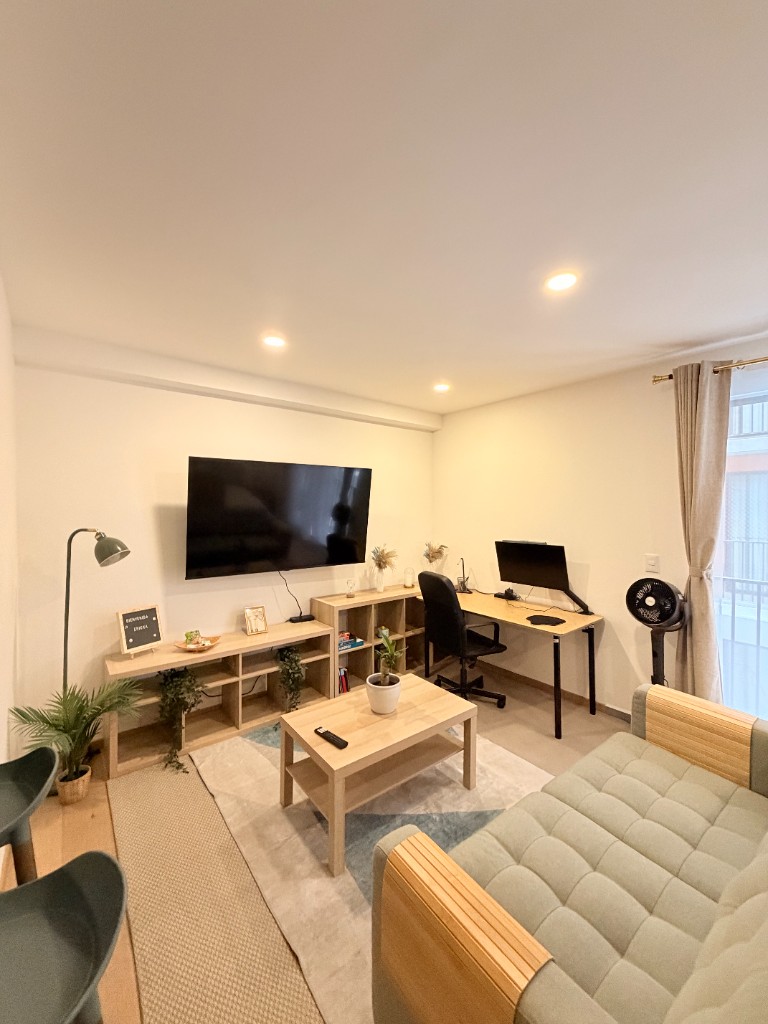
- A dedicated desk with a real chair beats “a dining table you can use” by week two. Wrist angle from a 75 cm dining table is wrong for 8 hours; back from a dining chair is worse. If the listing photo only shows the dining table, assume there’s no desk.
- The kitchen needs real cookware (frying pan + 2 pots + a sharp knife, not the dull Ikea one), salt and pepper at minimum, and a refrigerator that fits more than a few days of groceries from Mercado Medellín or La Comer. A “stocked kitchen” with no oil and no garlic isn’t stocked.
- For laundry, in-unit beats building beats lavandería. A lavandería costs ~$80–120 MXN per load with 24-hour turnaround: doable for a week, friction for a month.
- You need enough drawer and closet space to unpack the whole suitcase. Living out of a bag past day 10 slowly wears the stay down.
- Check-in needs explicit instructions for arrivals after 10pm. AICM landings from US/Canada often arrive 8–11pm, and buildings with daytime-only doormen become a problem.
- Support means a human contact for apartment issues (a broken lock, a water cut, an internet outage), not a chatbot that escalates after 24 hours.
The same apartment can photograph beautifully and still fail for a 3-week stay if these details are weak, and most do.
The real difference is not just length. It is lifestyle.
An apartment can feel great for 10 nights and tiring for 35 if the setup is weak, so a guest staying longer should look beyond “furnished” and confirm:
- Whether the workspace is real or improvised
- Whether the kitchen supports normal eating habits
- Whether the neighborhood matches workdays as well as weekends
- Whether the host communication is good enough for a longer stay
If you are working remotely, also read our digital nomad apartments in CDMX guide.
Short-term rental vs hotel vs monthly apartment
For Mexico City, the choice usually looks like this:
| Stay type | Best for | Weak point |
|---|---|---|
| Hotel | Short visits, daily cleaning, simple logistics | Less space, limited kitchen, weaker work routine |
| Furnished short-term rental | 1 to 4 weeks, relocation scouting, remote-work trials | Can become expensive or impractical if the stay becomes monthly |
| Monthly apartment | 30+ nights, remote-work routine, relocation, corporate stays | Requires more confidence in dates and neighborhood fit |
If your dates are still fluid, a furnished short-term rental gives you flexibility. If your dates are already close to a month, compare monthly options early so you do not overpay for a stay that is functionally monthly.
What furnished short-term rentals in Mexico City cost (2026, MXN)
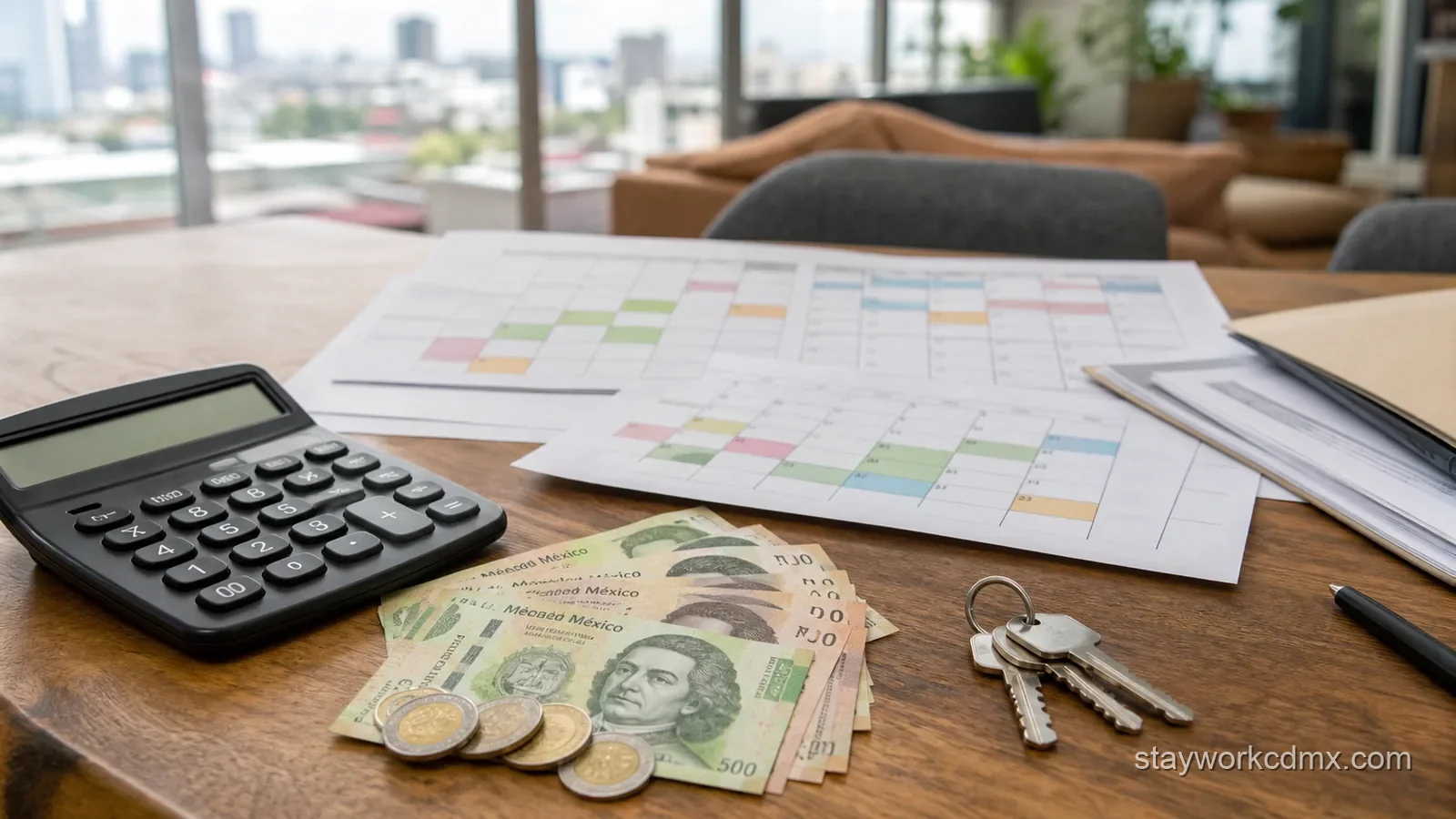
Pricing usually settles the short-vs-monthly decision on its own. These bands reflect real 2026 rates for serviced furnished stays in central CDMX, with utilities, Wi-Fi, and linens included:
| Stay length | Roma Norte — full 1BR | Narvarte — private room + bath | Narvarte — full 1BR |
|---|---|---|---|
| Nightly (under 2 weeks) | $740–$1,300 MXN/night | $300–$575 MXN/night | $550–$900 MXN/night |
| 2–4 weeks (typical total) | $12,000–$28,000 MXN | $5,000–$12,000 MXN | $9,000–$20,000 MXN |
| 30+ nights (monthly total) | $23,000–$33,000 MXN | $9,000–$17,000 MXN | $22,000–$32,000 MXN |
Three things stand out:
- The per-night price drops at the monthly threshold. A Roma Norte one-bedroom at $1,000 MXN per night is $28,000 for four weeks, but a monthly quote for the same unit often lands in the same $23,000–$33,000 band for more nights. Around the 26–28 night mark, extending to a full month can cost little or nothing extra.
- Platform fees stack up on short stays. Nightly bookings through Airbnb-style platforms add service fees of roughly 14–16% that monthly direct bookings largely avoid. On a $20,000 MXN stay, that is ~$3,000 MXN of pure fee.
- Neighborhood is the biggest lever after length: Narvarte prices 15–30% below Roma Norte for comparable units. If your stay is value-driven, start with the furnished monthly apartments in Narvarte inventory; if walkability is the priority, the Roma Norte monthly stays page shows what the premium buys.
Budget beyond rent is comparatively gentle: groceries for one run $3,500–$5,000 MXN per month, a lavandería load $80–$120 MXN, metro rides $5 MXN, and a coworking day pass $150–$350 MXN when the apartment desk is not enough.
Roma Norte vs Narvarte for shorter and longer stays
The neighborhood question changes with trip length too.
Roma Norte
Roma Norte usually wins for shorter, more social stays. The Orizaba–Medellín–Álvaro Obregón corridor puts a hundred cafés, restaurants, and coworkings inside a 15-minute walk. Parque México and Parque España are at the edge for evening walks. Metro Insurgentes (Línea 1) and Metrobús Álvaro Obregón serve the east side, and Reforma sits at the north edge for the airport-to-Roma route.
Choose Roma Norte if you want walkable restaurants, a stronger social scene, café workdays as the default, and short Uber rides to Condesa, Juárez, and Reforma. The trade-off is weekend noise on Av. Insurgentes and Cuauhtémoc, and Friday and Saturday nights run loud past midnight along Álvaro Obregón.
If Roma is already your preferred area, compare the practical setup on our furnished apartments in Roma Norte page. For dates of 1 to 4 weeks, use the 3-week apartment in Roma Norte page or the deeper guide to short-term rentals in Roma Norte, Mexico City . If you are torn between Roma and its leafier neighbor, the Roma Norte vs Condesa monthly-stay comparison settles that block by block.
Narvarte
Narvarte usually wins as the stay gets longer. The rhythm is calmer, daily costs typically run 15–25% below Roma for comparable furnished units, and the Eje 6 / Av. Cuauhtémoc grid puts you one Metrobús ride from Centro Histórico, Coyoacán, or Polanco. Centro Médico (Línea 3 + Línea 9) is a 10–15 minute walk from most of east Narvarte, which is why medical residents and nursing staff cluster here.
Choose Narvarte if you want a residential base, strong transit (Línea 3 down Cuauhtémoc, Metrobús Línea 1 along Insurgentes), quieter weeknights, and better value for a stay that may turn monthly. The trade-off is thinner walkable nightlife than Roma, so you either take an Uber out for Friday dinner or stay local. If Narvarte’s value appeals but you want slightly wider streets and more mid-rise buildings, the Del Valle monthly cost and routine breakdown covers the closest alternative, one colonia west.
For a deeper comparison, see Roma Norte vs Narvarte for a month in CDMX . If Narvarte is already your top choice, read short-term rentals in Narvarte, Mexico City before comparing monthly options. If the stay is built around remote work, the Narvarte guide for remote workers maps the cafés, gyms, and quiet blocks that make a longer stay sustainable.
How to choose the right format for your dates
A simple rule of thumb:
- If your stay is under three weeks, start with the short-stay question: convenience first
- If your stay is three to four weeks, compare both options carefully
- If your stay is 30+ nights, treat it like a monthly-living decision, not a longer vacation booking
The wrong format usually hurts in the same places:
- The cost feels worse than expected
- The apartment is less practical than it looked
- The neighborhood fit breaks down after the novelty wears off
Quick checklist before you book
Use this checklist before paying for any furnished short-term rental in Mexico City:
- Confirm the exact location or nearest cross streets
- Ask what is included in the price: utilities, internet, cleaning, taxes, and fees
- Check whether the bed, workspace, and kitchen match your daily routine
- Look for recent reviews that mention Wi-Fi, noise, check-in, and host communication
- Compare the total cost against a monthly quote if your stay is near 30 nights
- Make sure arrival and departure rules fit your flights
- If you need an invoice or company documentation, ask before booking
For a deeper version, use the monthly apartment checklist .
Where StayWork fits
StayWork CDMX works best for guests moving out of “short trip” mode and into mid-term living (call it 14 nights and up, with most guests staying 25–45 nights). Our furnished stays in Roma Norte and Narvarte include dedicated desks, 200+ Mbps Wi-Fi, self check-in for late AICM arrivals, and in-unit laundry as standard.
If your dates already look like a month, go to monthly rentals in Mexico City . To compare details before committing, use the monthly apartment checklist .
For live inventory and dates, use Book Direct . For remote-work planning, start with digital nomad apartments in CDMX .
Next step by decision
- Your stay is close to 30 nights: start with monthly rentals in Mexico City , or the cost-focused guide to apartments for rent in Mexico City monthly .
- Your stay may stretch past three months: read long-term rentals in Mexico City for foreigners before committing to any format.
- You are choosing a neighborhood: use where to stay in Mexico City for a month , or the ranked best neighborhoods in Mexico City for remote workers in 2026 .
- You need a work setup: review digital nomad apartments in CDMX .
- You are ready to check availability: go to Book Direct .