Every year, a growing number of digital nomads add Oaxaca City to their shortlist — and then immediately second-guess themselves when they look at the internet reviews. Mexico City or Oaxaca? One is a 22-million-person megacity with world-class infrastructure and a Nomad List score of 68.76/100. The other is a 300,000-person colonial city with a food culture that rivals anywhere on the continent and a price tag $400–$600 USD/month lower.
They are not interchangeable options. They are different propositions — and the right answer depends entirely on what you’re optimizing for.
This comparison uses real 2026 data: Nomad List scores, Numbeo and Expatistan cost figures, published rental prices, and four years of operating furnished apartments for remote workers in Roma Norte and Narvarte.
Quick Answer
CDMX vs Oaxaca: 30-second verdict
Choose Oaxaca City if: your budget is under $1,200 USD/month, you want to slow down, you’re genuinely here to experience Mexico, and you’re willing to solve the internet problem by working from a coworking space.
Choose Mexico City if: your work requires consistent, fast internet from your apartment, you fly internationally more than once a month, you need medical infrastructure, or you want a city that sustains a 3–6 month stay without running out of things to discover.
On cost: Oaxaca wins by $400–$600 USD/month. No argument. On work infrastructure: Mexico City wins, and it’s not close. The smart play for most nomads: do both.
The Numbers Side by Side
CDMX vs Oaxaca City — key metrics for digital nomads, 2026
| Category | Mexico City (CDMX) | Oaxaca City |
|---|---|---|
| Monthly budget (solo, comfortable) | $1,400–$2,200 USD | $800–$1,400 USD |
| Furnished 1BR, nomad neighborhood | $700–$1,400 USD/month | $450–$900 USD/month |
| Nomad List overall score | 68.76 / 100 | ~60 / 100 |
| Internet (modern apartment) | 100–300 Mbps fiber, standard | 20–50 Mbps avg; frequent outages |
| Coworking hot desk/month | $120–$250 USD | $50–$120 USD |
| Altitude | 2,240 m (7,350 ft) | 1,550 m (5,085 ft) |
| Average temperature | 17–20°C (cool/mild) | 22–26°C (warm, sunny) |
| Tourist visa (US/EU/UK) | 180 days, no application | 180 days, no application (same country) |
| International flights | Hub airport (AICM + AIFA) | Limited — mostly via CDMX |
| Medical infrastructure | World-class (ABC, Médica Sur, CMXXI) | Limited for complex needs |
| City population | 22M metro | ~300,000 |
Cost of Living: The Real Numbers
Oaxaca is genuinely cheaper — across every category, not just rent. A solo remote worker living well in Jalatlaco or Centro Histórico spends $800–$1,400 USD/month including a furnished apartment, groceries, eating out regularly, mezcal, and transport. The same lifestyle in Roma Norte runs $1,400–$2,200 USD/month.
The gap is widest in housing. In 2026:
- Oaxaca furnished 1BR (Jalatlaco, Centro, Reforma): $450–$900 USD/month depending on quality and location
- Roma Norte furnished 1BR: $700–$1,400 USD/month for a modern, work-ready unit
Eating in Oaxaca is exceptionally cheap without sacrificing quality — the opposite of what you’d expect. A bowl of tasajo negro or a plate of tlayuda at a market costs $2–$4 USD. A full sit-down dinner at a restaurant in Jalatlaco is $10–$20 USD. In Roma Norte, a comparable sit-down dinner runs $15–$30 USD. Street food is cheap in both cities, but Oaxaca’s market food competes with some of the best restaurant cooking in Mexico.
The one cost that narrows the gap: coworking. If you can’t reliably work from your Oaxaca apartment — and many nomads can’t — you’re adding $50–$120 USD/month for a coworking membership. Still cheaper than CDMX overall, but it’s a real line item to account for.
Neighborhoods: Jalatlaco vs Roma Norte

Barrio de Jalatlaco, Oaxaca City. In 2023, it became Mexico’s first Barrio Mágico — a designation that matches the lived experience of walking its calles.
Jalatlaco is the neighborhood that converts people. It is small enough to feel like a village — you will run into the same faces at the coffee shop, the mezcalería, and the Sunday market — but deep enough to sustain a month without boredom. Colonial walls painted terracotta and ochre, bougainvillea climbing iron balconies, cobblestones that slow everything down to a pace the neighborhood seems to enforce by design. There are cafes with decent Wi-Fi (variable but functional for email and async work), a handful of guesthouses, and a community feel that nomads in bigger cities often say they miss.
Centro Histórico gives you more options: the Zócalo, the Mercado 20 de Noviembre, Mercado Benito Juárez, and the density of restaurants that makes Oaxaca a food destination in a class of its own. Slightly louder, more tourist-facing, but also more alive on weekday afternoons. Most of the coworking spaces are accessible from Centro.
Roma Norte is the comparison point in Mexico City. It is a working neighborhood that also happens to be excellent for remote workers — dense with cafes, coworking spaces, markets, and restaurants, but with an independent local life that doesn’t revolve around tourists or nomads. The infrastructure is superior in every measurable dimension. The energy is faster. For a short stay, the ease of Jalatlaco is hard to argue with. For a three-month work sprint, Roma Norte is more practical.
If you’ve already decided on CDMX, our digital nomad apartments in CDMX page has current availability filtered specifically for remote workers — dedicated desks, fast fiber, monthly pricing.
Internet: The Real Problem
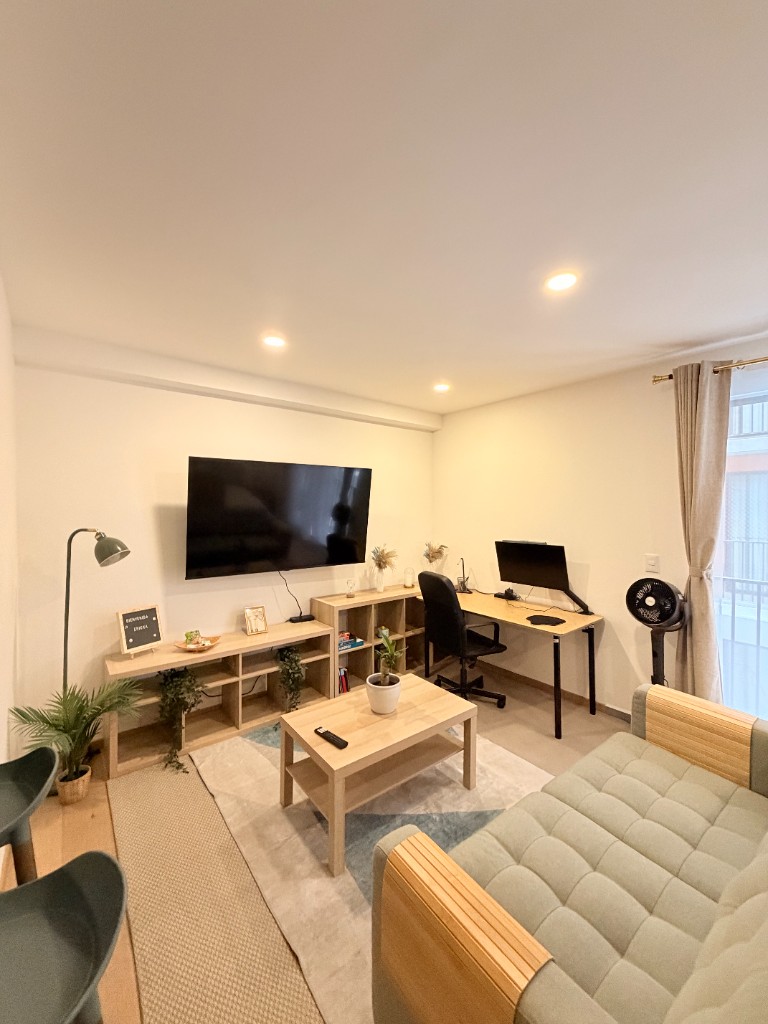
A dedicated desk setup in our Roma Norte apartment — 200 Mbps fiber, ergonomic chair, 27-inch QHD monitor. The difference from a Oaxaca apartment isn’t theoretical.
This is where the comparison gets uncomfortable, because Oaxaca’s internet situation is genuinely difficult and most travel blogs undersell it.
The honest picture: Fiber infrastructure exists in Oaxaca City, but coverage is uneven. Many apartments — including modern, well-maintained ones in Jalatlaco — run on 20–50 Mbps connections that are adequate for browsing but stressed by simultaneous video calls and cloud uploads. Outages happen, and they don’t get resolved on the same timeline you’re used to. Some newer buildings and coworking spaces do have 100 Mbps service, but it requires actively vetting your accommodation before booking.
The coworking workaround is real and it works. Spaces like CoWork Oaxaca and others in Centro charge $50–$120 USD/month for reliable connections. Nomads who commit to working from a coworking space have no meaningful internet complaint. The cost is lower than CDMX coworking ($120–$250 USD/month), and some Oaxaca spaces are excellent. You can check coworking options in CDMX for a comparison baseline on what “good” infrastructure looks like.
The hidden cost is the friction: getting dressed to go work instead of opening your laptop at your desk is a small thing per day that compounds across a month. If your workflow requires spontaneous Zoom calls, quick “five minutes” of work at 8pm, or a stable connection for large file transfers, the coworking dependency matters.
Mexico City’s standard is 100–300 Mbps dedicated fiber in modern apartments, with the coworking market functioning as an enhancement rather than a necessity.
Food Culture: A Different Kind of Parity
This is where Oaxaca does something remarkable: it matches CDMX in its own register rather than losing.
Oaxaca’s food culture is not lesser than Mexico City’s — it is different. The seven moles (negro, rojo, coloradito, amarillo, chichilo, verde, manchamanteles), tlayudas the size of serving platters, memelas, tasajo, chapulines toasted with lime and sal de gusano, and a mezcal culture that doesn’t apologize for itself. The Mercado 20 de Noviembre is a serious destination — an open-air grill hall where whole cuts of beef and carne asada cook over charcoal and you eat standing up for $4 USD. These are not tourist approximations of Oaxacan food; this is the source.
Mexico City’s food is broader and more varied — the scale of a 22-million-person city means every regional cuisine of Mexico, plus serious international dining, plus the taco culture that CDMX has always owned. The depth is unmatched at the continental level. But Roma Norte does not have a Mercado 20 de Noviembre, and no restaurant in Mexico City serves tlayudas the way Oaxaca serves tlayudas.
For nomads who care about food — and most do, because it becomes the texture of daily life across a month-long stay — neither city loses this category. They’re playing different games, and both are excellent.
Flights and Logistics
This is a clear win for Mexico City. The Benito Juárez International Airport (AICM) and the newer AIFA together connect to dozens of North American, European, and Latin American destinations with direct and daily service. If you fly internationally more than once a month — or if your visa, client meetings, or family situation requires predictable exit options — Mexico City’s connectivity is a material advantage.
Oaxaca’s airport (OAX) has improved but remains limited in scope. Most international travel routes through CDMX, which adds a connection and a night whenever you’re leaving Mexico. There are a small number of direct routes to US cities (Dallas, Houston, Los Angeles), useful if those are your home bases, but the overall connectivity is thin. For a nomad doing a focused month in Oaxaca with no planned travel, this doesn’t matter. For someone who needs to be in Toronto or Barcelona on 72 hours’ notice, it matters significantly.
Compared with other warm-weather alternatives like Medellín , Oaxaca’s flight connections are also more limited — Medellín has more direct international routes than OAX.
Medical Infrastructure
Straightforward: Mexico City wins, and the gap is large.
CDMX has world-class hospitals — ABC Medical Center, Médica Sur, Centro Médico Nacional Siglo XXI — with English-speaking staff, international insurance compatibility, and the full range of specialist care. For nomads managing chronic conditions, for anyone who might need surgical care, or for long stays where health confidence matters, CDMX’s medical infrastructure is a genuine quality-of-life factor.
Oaxaca has hospitals and clinics adequate for routine care — infections, minor injuries, general practice. For complex needs, specialist procedures, or emergencies requiring advanced imaging or surgery, the standard of care and the range of options are more limited, and transfer to CDMX or another major city may be required.
This is not a reason to avoid Oaxaca. It is a reason to have good travel insurance and to factor it into the length and terms of your stay.
Climate and Altitude
Oaxaca is warmer, sunnier, and easier on arrival. At 1,550 m (5,085 ft) and at a latitude that means genuine sunshine most of the year, Oaxaca City averages 22–26°C with warm days, cool evenings, and a dry season (October–May) that is essentially perfect weather. The rainy season brings afternoon showers, mostly June–September, that clear quickly. If warm weather and sunshine are non-negotiable, Oaxaca is better.
Mexico City is cooler and higher. At 2,240 m (7,350 ft) — 700 meters above Oaxaca — CDMX has mild spring-like days averaging 17–20°C with cool evenings that require a jacket year-round. The rainy season (June–October) brings afternoon showers but rarely all-day grey weather. Some visitors experience 1–3 days of altitude adjustment on arrival (headaches, fatigue); Oaxaca rarely causes this.
For most nomads, the climate difference is pleasant rather than decisive — CDMX is not cold, and Oaxaca is not extreme. But if you’re coming from a tropical climate and dreading altitude, Oaxaca’s 1,550 m is more comfortable.
Who Should Choose Each City
Choose Oaxaca City if:
- Your budget is under $1,200 USD/month and you need to stretch your runway
- Warm, sunny weather matters to you more than infrastructure density
- You’re doing an experience-first stay — you came to understand Mexico, not just work from it
- You can commit to a coworking routine for reliable internet
- You want a small-city community feel: running into the same people, slower pace, genuine local life
- You’re planning 4–6 weeks, not a marathon 3-month work sprint
Choose Mexico City if:
- You need reliable, fast internet from your apartment — no coworking dependency
- You fly internationally more than once a month
- Your work requires spontaneous calls, large uploads, or consistent performance across a long stay
- You want the deepest food and cultural scene in Latin America across a 2–6 month base
- Medical access matters for your situation
- You’re drawn to the largest nomad and startup community on the continent
The Honest Verdict
Oaxaca City is not a lesser version of Mexico City. It is a genuinely wonderful place to live for a month — beautiful, warm, affordable, and with a food culture that any serious eater should experience firsthand. The nomads who love it are not settling. They’re choosing differently.
The hard constraint is internet. If your work tolerates a coworking routine and you don’t have unpredictable flight needs, Oaxaca works. If your work requires apartment-quality internet on-demand and your itinerary has frequent international departures, it doesn’t — not cleanly.
The most honest advice: the question isn’t CDMX vs Oaxaca. It’s CDMX and Oaxaca, in sequence. Do 4–6 weeks in Oaxaca to slow down, eat well, and actually experience the country. Then move to CDMX for a serious work month with full infrastructure. Both cities are better understood as complements than competitors, and the nomads who do both consistently say the combination is better than either city alone.
Budget-first nomads and slow travelers: Oaxaca. Work-first, reliable-internet-required, flight-dependent nomads: CDMX. Everyone else: do both.
For monthly stays
Ready for your CDMX month? See what's available
If you’re committed to CDMX and choosing between neighborhoods, continue with Roma Norte vs Condesa for monthly stays , Roma Norte vs Narvarte for a monthly stay , and cost of living in Mexico City for digital nomads .
For booking flow after your city decision:
- Browse digital nomad apartments in CDMX if desk setup and call reliability are your top filters.
- Compare short term rentals in Mexico City if you are still choosing between Roma Norte and Narvarte.
- Use book direct in Mexico City when you want live availability and direct support.
Sources and further reading
Figures in this guide combine public cost-of-living datasets, city comparison tools, published rental prices, and booking-platform snapshots. Prices and scores move over time — confirm current numbers before you book.
- Nomad List — Mexico City
- Nomad List — Oaxaca
- Numbeo — Cost of Living in Mexico City
- Numbeo — Cost of Living in Oaxaca
- Expatistan — Mexico City vs Oaxaca
- Secretaría de Turismo — Barrios Mágicos de México (Jalatlaco designation, 2023)
- Published listing snapshots on Airbnb and Booking.com (May 2026 sample checks)
Spanish Search Intent
If you are searching in Spanish, this comparison usually appears as CDMX vs Oaxaca para nómadas digitales, costo de vida Oaxaca vs Ciudad de México, internet en Oaxaca para trabajo remoto, or dónde vivir un mes trabajando remoto en México.
Spanish readers can continue with: