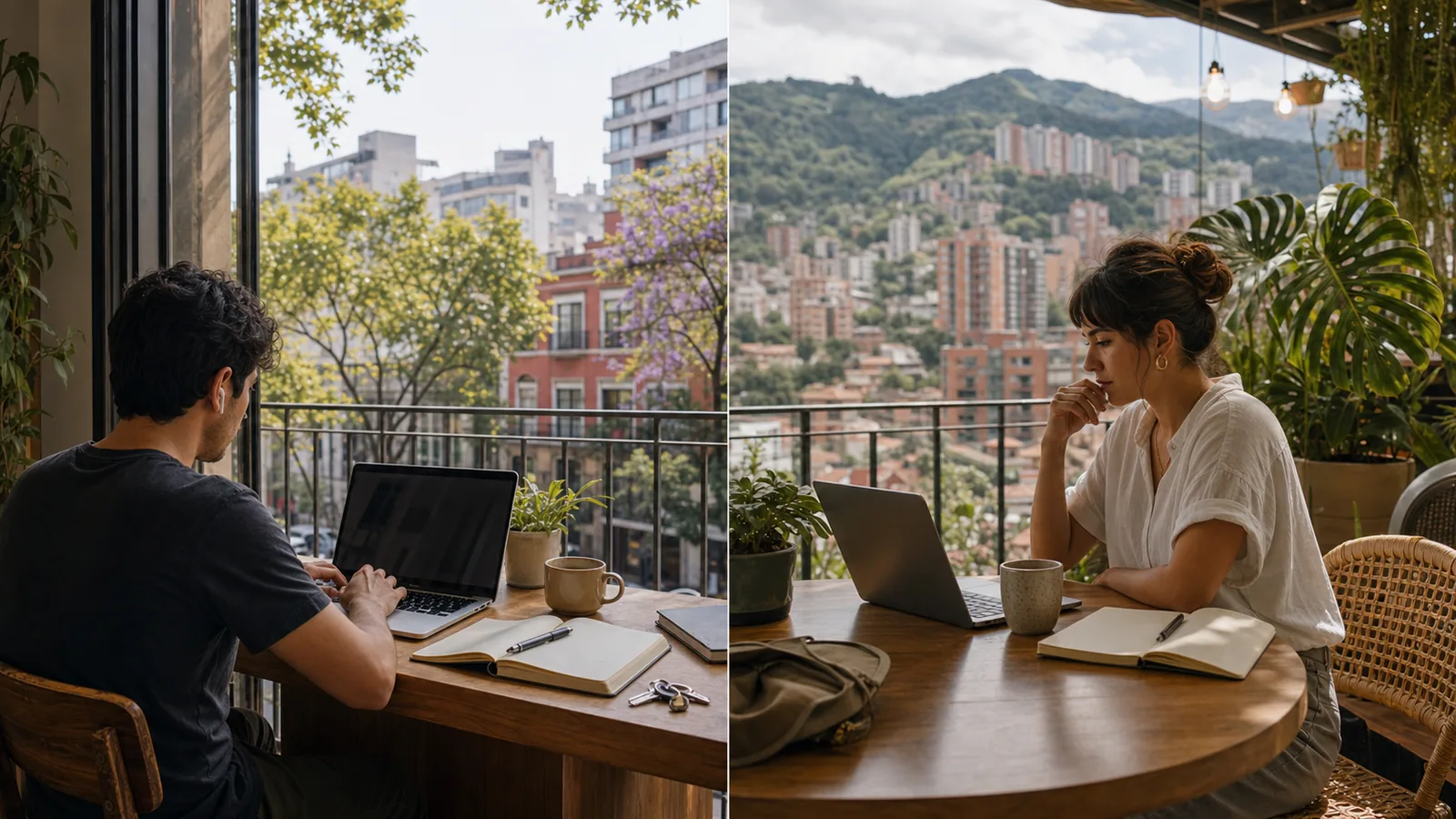
Every year, thousands of digital nomads open the same tab: Mexico City or Medellín? Both are in the top five Latin American cities on Nomad List. Both have modern apartments, fast internet, and active expat communities. Both are significantly cheaper than Europe or North America.
But they are not the same city — and the wrong pick costs you months of friction, money, or both.
This comparison is built on real 2026 data: cost of living figures from Numbeo and Expatistan, Nomad List scores, published rental prices, and ground-level knowledge from running furnished apartments for remote workers in Roma Norte and Narvarte since 2022.
Quick Answer
CDMX vs Medellín: 30-second verdict
Choose Medellín if: your budget is under $1,200 USD/month, you prioritize warm weather year-round, and you want a concentrated nomad community in a smaller, easier-to-navigate city.
Choose CDMX if: you want the best food in Latin America, the largest English-speaking nomad community on the continent, a world-class cultural scene, and a city you can live in — not just visit — for 3–6 months without running out of things to discover.
On pure cost: Medellín wins by $400–$700 USD/month for equivalent quality. On depth, variety, and long-stay livability: Mexico City wins by a mile.
The Numbers Side by Side
CDMX vs Medellín — key metrics for digital nomads, 2026
| Category | Mexico City (CDMX) | Medellín |
|---|---|---|
| Monthly budget (solo, comfortable) | $1,400–$2,200 USD | $900–$1,500 USD |
| Furnished 1BR, expat neighborhood | $700–$1,400 USD/month | $500–$1,200 USD/month |
| Nomad List overall score | 68.76 / 100 | 74.43 / 100 |
| Safety score (Nomad List) | 41 / 100 | 67 / 100 |
| Avg internet (modern apartment) | 100–300 Mbps | ~100 Mbps fiber |
| Altitude | 2,240 m (7,350 ft) | 1,495 m (4,900 ft) |
| Average temperature | 15–17°C (cool evenings) | 22–23°C year-round |
| Tourist visa (US/EU/UK) | 180 days, no application | 90 days, no application |
| Digital nomad visa | Residente Temporal (easy) | Requires $1,400 USD/month proof |
| Street food meal | $1.50–$4 USD | $1.50–$3 USD |
| Coworking hot desk/month | $120–$250 USD | $90–$180 USD |
| Direct flights to US/EU | Extensive (hub airport) | Good, fewer direct routes |
Cost of Living: The Real Numbers
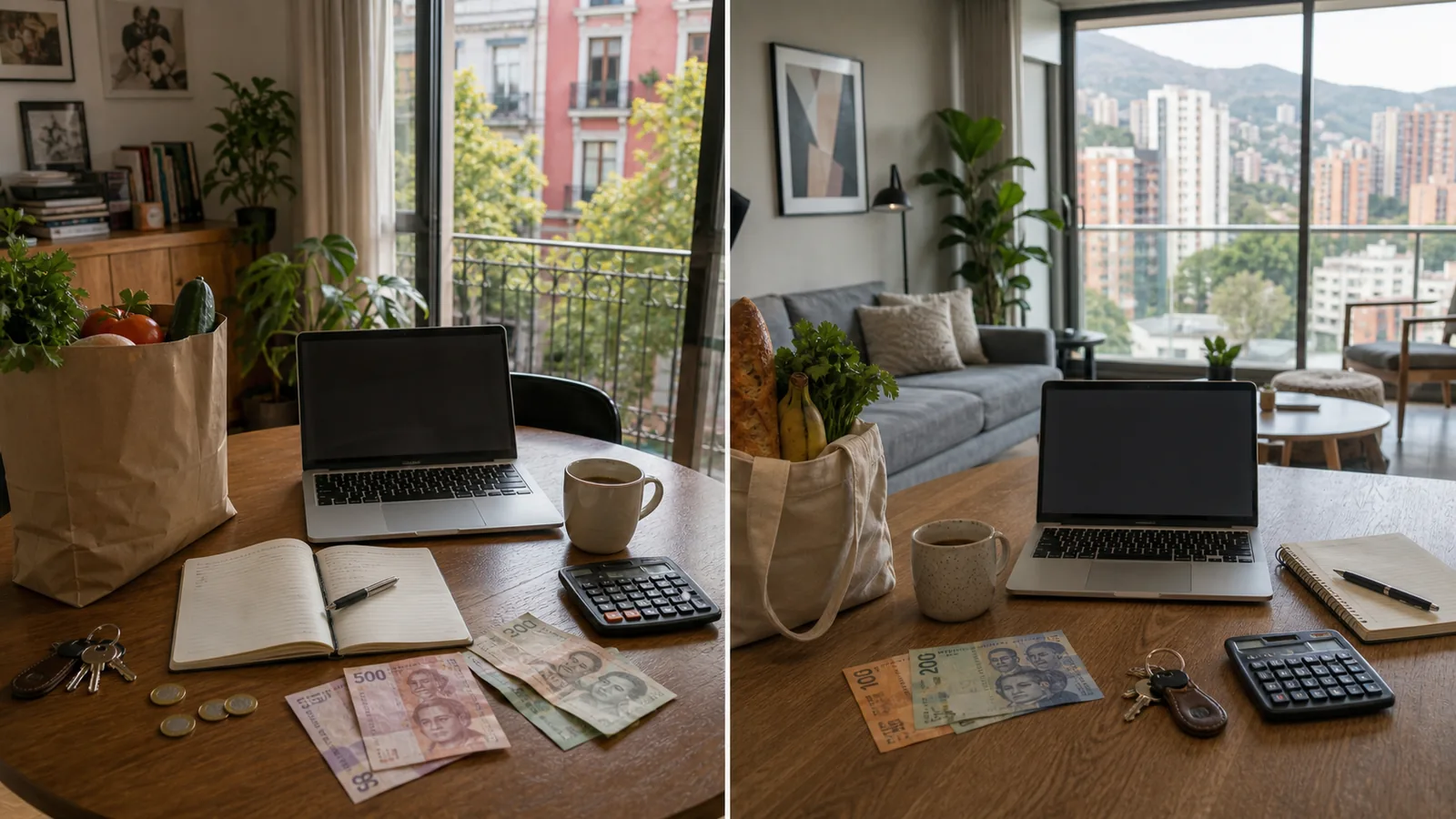
Medellín is cheaper. That’s just true. A solo remote worker living well in El Poblado or Laureles spends $900–$1,500 USD/month including a furnished apartment, groceries, eating out regularly, and transport. The same lifestyle in Roma Norte or Condesa runs $1,400–$2,200 USD — see our full CDMX cost-of-living breakdown for line-by-line categories.
The gap is widest in housing. In 2026:
- El Poblado furnished 1BR: $500–$1,200 USD/month (COP $2M–$5M/month) depending on building and amenities
- Roma Norte furnished 1BR: $700–$1,400 USD/month ($12,000–$24,000 MXN/month) for a modern, work-ready unit
Eating out in Medellín stays cheap even in expat neighborhoods. A sit-down lunch (menu del día) runs $4–$6 USD. In Roma Norte, a sit-down lunch at a decent restaurant is $8–$15 USD. Street tacos are still $1.50–$4 in CDMX, but the gap shows up across a full month.
The honest caveat on Medellín costs: El Poblado — the neighborhood most nomads actually end up in — has premiumized significantly since 2020. Many listings in the expat-heavy streets near Parque Lleras now command prices closer to $900–$1,100 USD/month for a decent furnished apartment, which narrows the CDMX gap more than the aggregate numbers suggest.
Neighborhoods: El Poblado vs Roma Norte
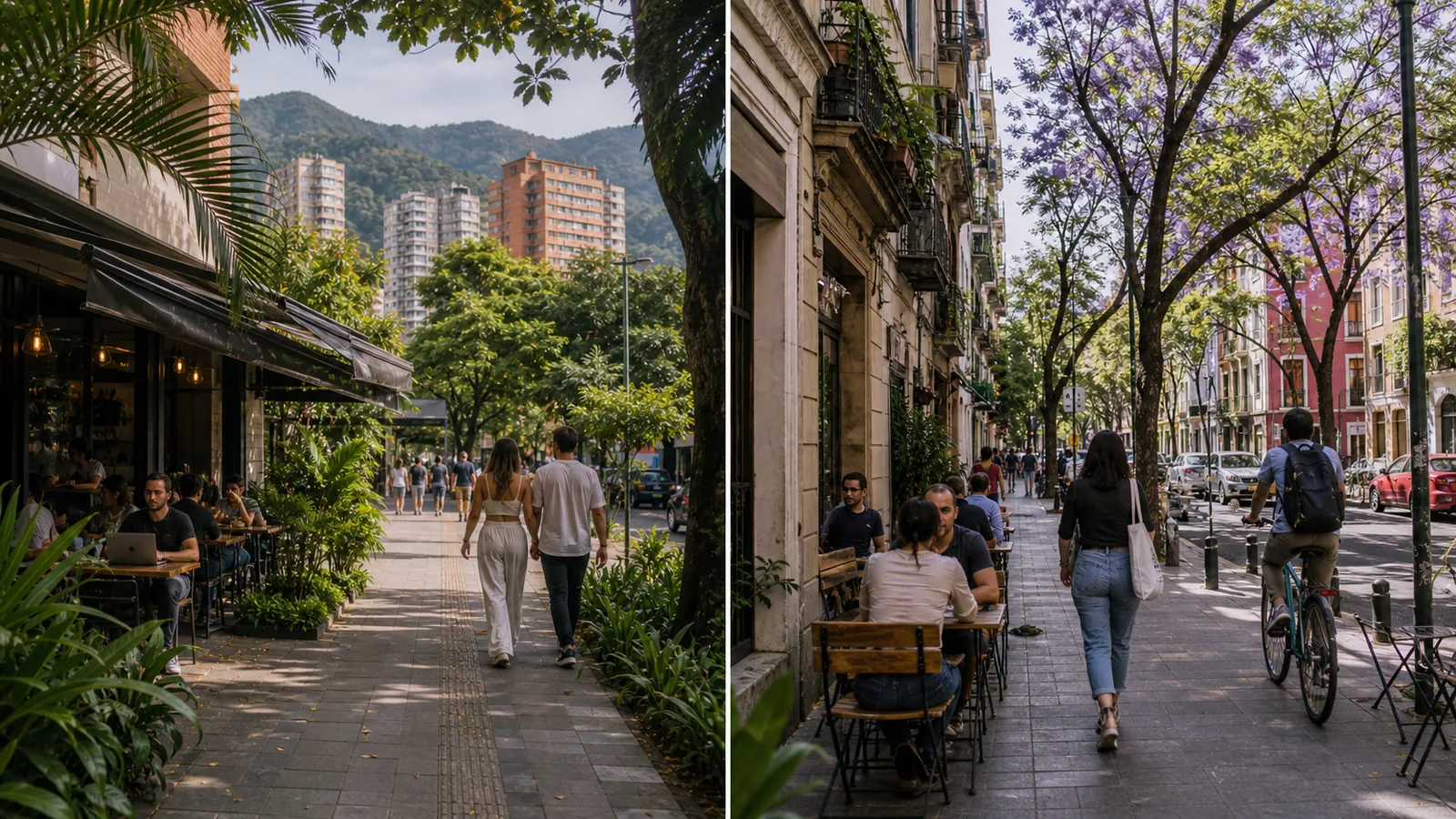
El Poblado and Roma Norte both support remote-work routines, but one feels more compact and expat-oriented while the other feels more layered and urban.
The comparison is really neighborhood vs neighborhood, and both cities have concentrated their nomad infrastructure in specific areas.
El Poblado (Medellín) is compact, walkable, and deliberately designed around the expat experience. Cafes with strong Wi-Fi, co-working spaces, smoothie bars, and English-language yoga studios line the main streets. It’s easy to arrive and feel immediately comfortable. The downside: it can feel like a bubble. Spend three months in El Poblado and you can go days without hearing Spanish or eating Colombian food in a non-tourist context.
Roma Norte (Mexico City) is a working neighborhood that happens to also be great for remote workers. There are coffee shops everywhere, a high density of coworking options, and restaurants that range from $1.50 tacos to $80 tasting menus — all within a 10-minute walk. It doesn’t have El Poblado’s compactness, but it has something more valuable: it feels like a real city. The people at the next table at your café are Mexican architects, local journalists, university students. The neighborhood has a life independent of you.
For a 2-week stay, El Poblado is arguably easier to navigate. For a 2-month stay, Roma Norte is richer.
Narvarte — the quieter, more residential neighborhood where our second property sits — has no direct Medellín equivalent; see our Roma Norte vs Narvarte monthly stay comparison if you are choosing between the two in CDMX. It’s where nomads end up after their first 30 days in Roma Norte when they want lower rent, less noise, and a calmer rhythm without leaving the city.
Internet and Work Setup
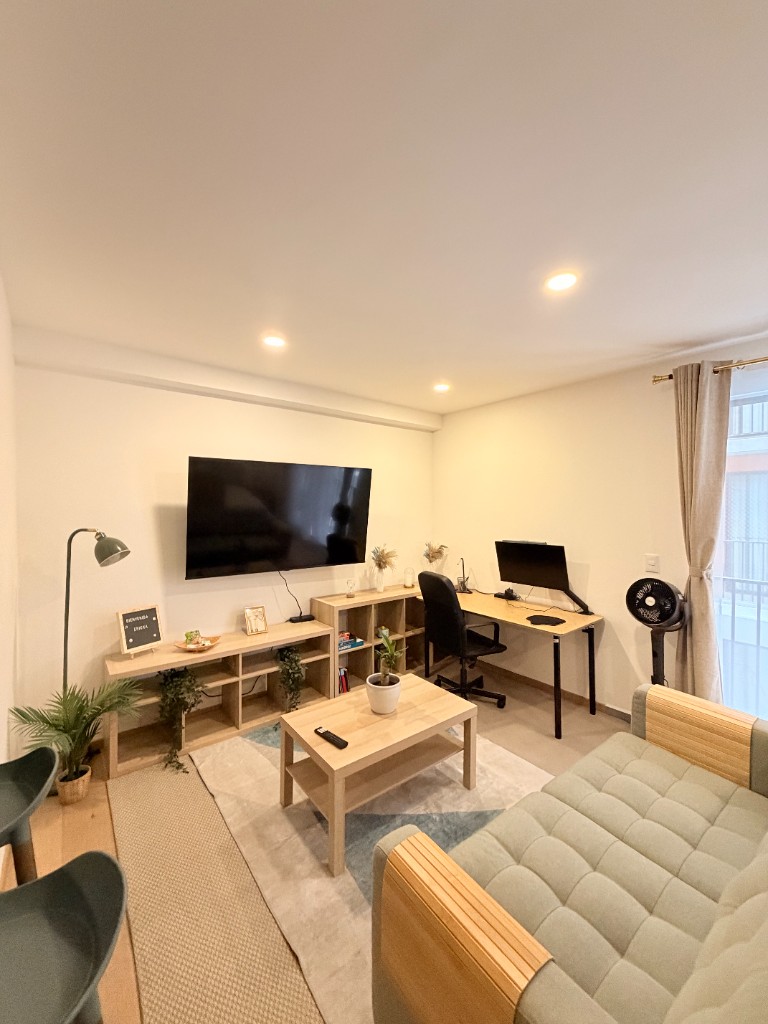
A dedicated desk setup in our Roma Norte apartment. 200 Mbps fiber, ergonomic chair, 27-inch QHD monitor — in-unit, not at a coworking space.
Both cities will support a professional remote work setup without problems.
Mexico City: 100–300 Mbps fiber is standard in modern apartments in Roma Norte, Condesa, and Narvarte. The coworking market is mature — over 15 spaces in Roma Norte alone , ranging from $120–$250 USD/month for a hot desk. Video calls, cloud uploads, async collaboration — no issues.
Medellín: Fiber is reliable through Claro and Tigo in El Poblado and Laureles. Average apartment speeds of ~100 Mbps are common. Coworking starts around $90–$180 USD/month. The infrastructure is solid, though less dense than CDMX overall.
The real difference: In Mexico City, it’s normal — even expected — to work from your apartment. The furnished rental market has evolved to include proper desks, ergonomic chairs, and fast dedicated fiber specifically because long-stay remote workers are a known guest type. In Medellín, many furnished rentals still treat the desk as an afterthought.
If your work setup matters — and it does over a 30–90 day stay — verify exactly what’s in the apartment before booking either city. If you want a faster pre-booking filter, use this Roma Norte furnished apartment remote-work checklist before you commit.
Food and Lifestyle
This is where the comparison becomes one-sided.
Mexico City has the best food culture in Latin America. That’s not a marketing claim — it’s a consensus position among chefs, food writers, and the millions of people who visit specifically to eat. From $30 MXN ($1.50) al pastor tacos at a corner stand to Contramar’s grilled fish to Quintonil’s tasting menu, the depth and variety is unmatched on the continent. Roma Norte specifically is dense with markets, bakeries, cantinas, and restaurants that would be destination dining in any other city.
Medellín has excellent food — bandeja paisa, arepas con choclo, sancocho — and the local Colombian food scene is genuinely worth experiencing. The international dining options in El Poblado are solid. But Medellín doesn’t have the raw ingredient quality, the culinary tradition depth, or the sheer variety of CDMX.
On nightlife and culture: Mexico City is one of the major cultural capitals of the Western Hemisphere. World-class museums (Museo Nacional de Antropología, Tamayo, MUAC), live music across every genre, theater, cinema, art galleries, and a nightlife scene that runs genuinely late. Medellín has an active nightlife — particularly in El Poblado and Parque Lleras — and a growing arts scene, but the scale difference is significant.
Safety: The Honest Answer
Safety is where most comparisons get dishonest. Let’s be direct.
Nomad List gives Medellín a 67/100 safety score versus CDMX’s 41/100. That gap is real, and it comes from concentrated infrastructure: El Poblado and Laureles are genuinely low-crime areas with good lighting, walkability, and a visible expat presence. Medellín has invested heavily in urban transformation since its violent past, and the results in these neighborhoods are visible.
Mexico City at 41/100 reflects the city average, not Roma Norte. Petty theft, pickpocketing, and opportunistic crime exist in tourist-heavy areas. Violent crime against tourists in Roma Norte, Condesa, and Narvarte is rare. The vast majority of long-term residents and nomads live in these neighborhoods for months without incident.
The practical reality:
- In Medellín: stay in El Poblado or Laureles, be careful at night in less familiar areas, and you’ll be fine
- In Mexico City: the same logic applies to Roma Norte, Condesa, Polanco, and Narvarte
Neither city requires paranoia. Both reward basic urban awareness.
Visa and Logistics

Mexico City wins on visa simplicity. Most nationalities (US, EU, UK, Canada, Australia) get 180 days on tourist entry — no paperwork, no income requirements, no prior application. If you want to stay longer, the Residente Temporal visa is well-documented and widely processed. Many nomads do 180 days as a tourist, leave briefly, and return.
Colombia’s Digital Nomad Visa officially requires proving income of at least $1,400 USD/month and a formal application process. For stays under 90 days, most nationalities enter visa-free — but the 90-day limit matters for longer stays. The digital nomad visa is legitimate but adds friction.
On flights: Mexico City’s Benito Juárez International Airport (and the newer AIFA) connects to North America, Central America, Europe, and Asia with dozens of direct routes. Getting in and out of CDMX is easy and often cheaper than routing through Bogotá. Medellín’s connectivity has improved but has fewer direct international routes.
Climate and Altitude
Medellín earns its “City of Eternal Spring” nickname. At 1,495 m elevation and near the equator, it maintains an average of 22–23°C year-round. Warm days, comfortable evenings, occasional afternoon rain. For nomads who prioritize weather, Medellín is genuinely hard to beat.
Mexico City’s climate surprises most visitors positively. At 2,240 m — significantly higher than Medellín — CDMX has mild, spring-like days averaging 20–22°C and cool evenings (12–15°C). There’s a rainy season (June–October) with afternoon showers, but rarely all-day rain. Winter nights (December–February) get cold enough to need a jacket.
The altitude difference matters for arrival. Mexico City’s 2,240 m means some visitors experience mild altitude adjustment in the first 1–3 days — headaches, fatigue, reduced appetite. It passes quickly for most. Medellín at 1,495 m rarely causes any adjustment issues.
Who Should Choose Each City
Choose Medellín if:
- Your monthly budget is under $1,200 USD and you need to stretch it
- Warm weather year-round is non-negotiable
- You want a tight-knit, English-speaking nomad community in a compact neighborhood
- You’re staying 1–2 months and want easy onboarding — if CDMX is still in the mix, use this first-week guide before you decide
- Colombian culture, food, and Latin Caribbean energy is what you’re after
Choose Mexico City if:
- You want the deepest food and cultural experience in Latin America
- You’re planning 2–6 months and want a city that rewards staying — compare neighborhoods with this monthly-stay guide
- You value visa simplicity (180-day tourist entry, no paperwork)
- Your work requires meeting people — CDMX has the largest nomad and startup community in Latin America
- You want direct, frequent, and affordable flights to/from North America and Europe
- You’re drawn to Roma Norte specifically — the neighborhood density of cafes, restaurants, coworking, and parks is unmatched
The Honest Verdict
Medellín is the better deal. If the monthly cost difference of $400–$700 USD matters to your runway, pick Medellín.
But Mexico City is the better city. It’s bigger, more complex, more layered, and more demanding — and it gives back more for the effort. Nomads who spend two months in CDMX consistently describe it as one of the most livable cities they’ve worked from anywhere. The food alone is worth the price premium for many.
The choice comes down to what you’re optimizing for. Budget and warmth: Medellín. Depth, culture, food, and long-stay richness: Mexico City. If you want a practical next step, you can review current monthly options in CDMX before choosing your neighborhood.
If you’ve already decided on CDMX, the next question is neighborhoods. Roma Norte gives you cafes, coworking density, and the most energetic version of the city. Narvarte gives you the same infrastructure at a calmer pace and a lower price point — and closer proximity to CDMX’s medical corridor if that matters.
For monthly stays
Working from CDMX? See what's available
If CDMX is your likely pick but you still need to decide your base, continue with Roma Norte vs Condesa for monthly stays , Roma Norte vs Narvarte for a monthly stay , and cost of living in Mexico City for digital nomads .
For booking flow after your city decision:
- Browse digital nomad apartments in CDMX if desk setup and call reliability are your top filters.
- Compare monthly rentals in Mexico City if you are still choosing between Roma Norte and Narvarte.
- Use book direct in Mexico City when you want live availability and direct support.
Sources and further reading
Figures in this guide combine public cost-of-living datasets, city comparison tools, and booking-platform pricing snapshots. Prices and scores move over time, so confirm current numbers before you book.
- Nomad List — Mexico City
- Nomad List — Medellín
- Numbeo — Cost of Living in Mexico City
- Numbeo — Cost of Living in Medellín
- Expatistan — Mexico City vs Medellín
- Medellin Guru — Medellín digital nomad visa guide
- Published listing snapshots on Airbnb and Booking.com (May 2026 sample checks)
Spanish Search Intent
If you are searching in Spanish, this comparison usually appears as CDMX vs Medellín para nómadas digitales, costo de vida CDMX vs Medellín, seguridad en Medellín vs Ciudad de México, or dónde vivir un mes trabajando remoto en Latinoamérica.
Spanish readers can continue with: